How Much Are Singing Lessons? Costs vs Apps for Adult Singers
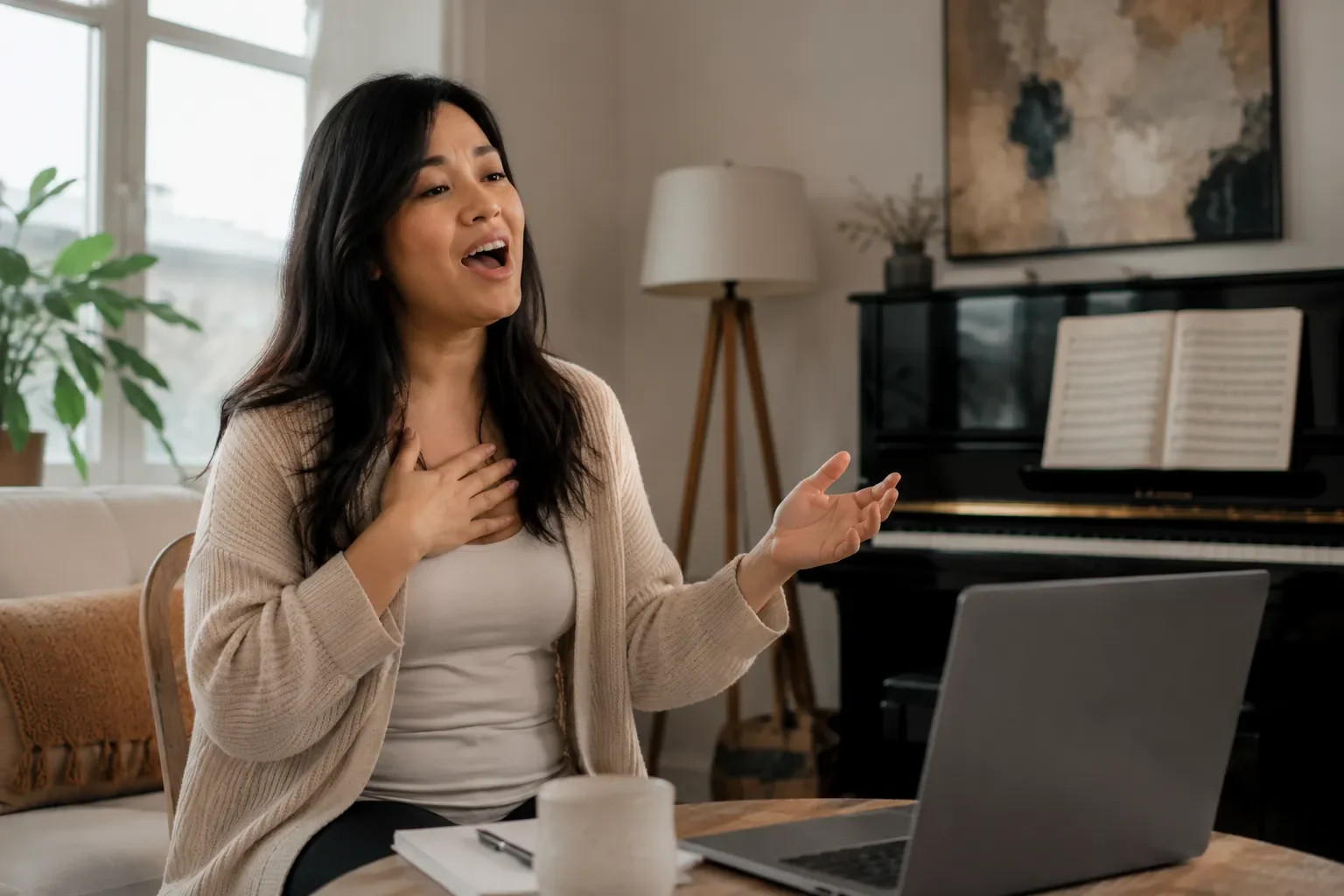
Adults ask me this constantly, and it almost always arrives as a confession: "I know I should probably get real lessons, but the apps are so much cheaper." After more than 25 years of teaching, here is my honest answer, and it is not the one that flatters my own profession.
For most adults coming back to it, an app is the better place to start and private lessons are the better place to go deeper. Many of my happiest students use both — an app for the daily five minutes, and a lesson every month or two when something specific needs fixing. But before any of that is worth discussing, you need real numbers, because the price gap is the thing everyone is actually asking about.
The short answer
In the US, private singing lessons run roughly $40 to $130 per hour, depending on where you live and who is teaching. Marketplace teachers average around $29 an hour; established studios in Los Angeles and the Bay Area quote $80 to $150. Singing apps cost $0 to about $40 per month — less than half of one lesson. Lessons buy you diagnosis. Apps buy you consistency. Which one you need depends on whether your problem is "I do not know what I am doing wrong" or "I never actually practice."
How much are singing lessons in 2026?
There is no single national rate, and anyone who quotes one is guessing. What there is instead is a spread you can navigate, once you know what sits at each end of it. Here is what the market actually looks like right now, drawn from published rates rather than from memory.
| What you are buying | Typical hourly rate | Who charges this |
|---|---|---|
| Marketplace average, all teachers | About $29/hr1 | National average across a large tutor marketplace, skewed by student and hobbyist teachers |
| Beginner or student teacher | $15–$35/hr1 | People early in their teaching career, often music majors |
| Online lesson, experienced teacher | $40–$80/hr2 | Independent teachers working over video, competing nationally rather than locally |
| In-person, experienced, major metro | $80–$150/hr2, 3 | Established studio teachers in the Bay Area and Los Angeles |
| Conservatory-level or industry coach | $140–$500+/hr2, 3 | Specialists with performance credentials, often working with professionals |
| Singing app, monthly | $0–$40/mo | Subscription apps, most with a usable free tier |
Rates as published by each source in early 2026. Smaller towns generally sit at the low end of each band; New York, Los Angeles and the Bay Area sit at the high end.
Why the range is so wide
A $29 lesson and a $150 lesson are not the same product with different markups. Four things move the number, and knowing which one you are paying for is most of the skill in buying lessons well.
Geography does the heaviest lifting. A Bay Area studio quoting $90 to $130 an hour and a small-town teacher quoting $45 may have similar training. One of them is paying Bay Area rent. This is also why online lessons undercut in-person ones so reliably — the teacher's cost base moves with them.
Experience is priced steeply. The jump from a new teacher to an established one is not gradual; it roughly doubles. Whether that doubling is worth it depends entirely on how hard your problem is. For a returning adult who mostly needs permission and a routine, it usually is not. For a stubborn break in the middle of the voice, it usually is.
Specialization costs more than credentials. A teacher who works specifically with belting, or with post-surgical voices, or with adults rebuilding after a long gap, charges more than a generalist with the same years in. You are paying for pattern recognition in your particular problem.
Studio overhead gets passed on. A chain music school charging $70 for half an hour is not paying the teacher $140 an hour. Some of that is room, scheduling, and admin. Independent teachers usually cost less for the same hour of attention, and are harder to find.
How much is a 30-minute singing lesson?
Half-hour lessons are the default for adults, and they almost never cost half the hourly rate. Expect roughly 55 to 65 percent of the hour price, because the teacher's fixed costs — the scheduling, the travel, the ten minutes of preparation — do not halve.
In practice, a $90-per-hour teacher will usually charge $50 to $60 for thirty minutes. Weekly, that is $200 to $240 a month. A $50-per-hour teacher lands nearer $30 for the half hour, or about $120 a month. Those two numbers — roughly $120 at the low end, roughly $240 at the high end — are the real monthly cost of a weekly lesson habit, and they are the numbers worth comparing an app subscription against.
Thirty minutes is genuinely enough at the beginning, by the way. Adult attention for focused vocal work runs out faster than adult enthusiasm does. I have watched plenty of sixty-minute beginner lessons where the last twenty minutes were tired repetition of the first forty.
Does online cost less than in person?
Usually, but not by as much as people expect. Online voice lessons for adults run about the same hourly rate as a local teacher once you are past the marketplace tutors, and the saving is mostly travel and the half hour either side of it. What online genuinely buys you is reach: an online vocal coach who works with returning voices, rather than whoever happens to teach within twenty minutes of your house. If affordable online singing lessons are the goal, the hourly rate matters less than how often you actually show up.
What apps cost, and what that money buys
Apps live in a different universe. Most subscriptions run between $10 and $40 per month, and genuinely usable free options exist, from free tiers to the endless supply of warm-up videos online. I have tested the best free singing apps against each other separately; this page is about whether an app or a teacher is the right spend at all. A whole month of a typical app costs less than half of one in-person lesson.
What that buys is a structured routine, a schedule that bends around your life, and in the better apps some pitch feedback. What it does not buy is a person who can see your jaw. Both facts matter, and neither one is on the pricing page.
See what Vocal Refresh does differently.
Built around register shifts, hormone changes and alto keys. A voice check sets your level and each session is five to twenty minutes. Founding members pay $69.99 a year, held for three years, with a free tier and a 14-day trial at launch. Join the waitlist and we email you the day it opens.
No spam. Leave any time.
Cheap buys consistency. Expensive buys diagnosis.
This is the sentence I wish every adult read before spending anything.
The price tag tells you what you are buying. It does not tell you which one you need.
An app will cheerfully guide you through thirty days of practice while you cement a breathy habit a coach would have caught in the first ten minutes. That is the failure mode of cheap: consistent reinforcement of something slightly wrong.
And plenty of people take a $90 lesson, drive home inspired, and do not sing a note until the next $90 lesson. That is the failure mode of expensive: excellent information, no repetition. Over a year, that person has spent roughly $4,700 and practiced about fifty hours, all of them supervised. The app user has spent about $200 and practiced perhaps 120 hours, none of them supervised. Neither of those is obviously the better trade.
So the useful question is not "which is better." It is "which of my two problems is bigger right now" — not knowing what to do, or not doing it.
When an app is the better choice
When you are building a habit rather than a performance. If you have not sung in years, the first job is not fixing your technique. It is getting your voice moving most days. Five minutes daily beats one heroic hour on Saturday for rebuilding coordination, and a short daily warm-up routine is the whole of what you need for the first month.
When self-consciousness is the wall. A surprising number of adults would rather do almost anything than sing in front of a stranger, including a kind and patient stranger. Practicing alone in the kitchen removes that barrier entirely, and confidence grows fastest when nobody is watching yet. If that is your main obstacle rather than the money, start with my singing confidence habits instead.
When your calendar is chaos. Parenting, shift work and travel all make a fixed weekly slot unreliable, and every canceled lesson costs money or goodwill. An app does not care that you only had time at 9:40pm on a Tuesday.
When you do not yet know what to ask for. This one is underrated. A first lesson goes much better when you can say "my voice gets tight around here" and point at a specific note. Two months with an app buys you that vocabulary, and makes the eventual lesson worth more. If you want the short version before you book anything, a free vocal range test takes about two minutes and gives you the two notes to bring with you.
When private lessons are worth the money
Anything physical. Strain, quick fatigue, a tightness you can feel but cannot locate. A trained ear and a pair of eyes can often spot the cause in minutes, and no app can watch your jaw or your shoulders. If singing hurts, stop reading comparison articles and book someone.
A plateau. If you have practiced consistently for months and stopped improving, something in your technique is holding the ceiling down, and finding it yourself is slow. A coach can usually name the habit in a lesson or two. The classic version of this is a stuck transition between chest voice and head voice, which is very hard to diagnose from inside your own head.
A deadline. A wedding song in June, an audition, a solo in the spring concert. When the date is fixed, personalized feedback compresses months of trial and error into weeks, and that is worth paying for.
A voice that has changed. After illness, surgery, pregnancy, or a long gap, the instrument you are working with is not the one you remember. A few lessons to remap it saves months of frustrated guessing.
Can an app replace a vocal coach?
For the first several months, mostly yes. Warm-ups, daily routines, pitch work, rebuilding range and stamina — apps handle all of that well, and they handle the consistency problem considerably better than lessons do.
What no app replaces is a human who understands why a note feels hard for you specifically, or who can sit with the strange grief of "I used to sing" that so many returning adults carry. Some of what happens in my studio is technique. A lot of it is permission.
The other thing a coach provides that no app has solved is correction of what you cannot hear. Your own voice reaches your ears through bone as well as air, which is why recordings sound wrong to you. An app that scores your pitch is measuring one dimension of a problem that has four or five.
What a realistic first year looks like
Here is the plan I actually give people, and roughly what it costs.
Months one to three: app only. Five to ten minutes most days. Budget $0 to $120 for the quarter. The goal is not improvement, it is attendance. If you are still opening it in week six, the plan is working.
Month four: one lesson. Book a single hour with a good teacher and bring specific questions, which you now have. Budget $50 to $130. This one lesson, taken after three months of daily practice, is worth more than the first four lessons of someone who has not practiced at all.
Months five to twelve: app daily, lesson every six to eight weeks. Budget roughly $300 to $800 for the rest of the year. That is a total first year somewhere between $400 and $1,000, against about $4,700 for weekly lessons alone — and in my experience the blended version produces the better singer, because the practice hours are where the change happens.
Which should you open tomorrow?
Do not let this question stall you for another week. Start with whichever one you will actually open tomorrow. For most adults that is an app, followed by a lesson later when a specific issue shows up. The genuinely bad option is a third week of research with no singing in it.
If you go the app route, my selection criteria for adults coming back to it are short routines, no forced recording on day one, and exercises that meet your current range rather than a generic baseline. I compared everything on the market against those in my guide to the best singing and vocal training apps. The individual write-ups — Yousician, Simply Sing, Singing Carrots and the rest — live in my singing app reviews hub. And if you are starting from zero rather than returning, my roadmap for learning to sing as an adult walks the whole path from first note to first song.
Full disclosure: I also built an app for exactly this situation. Vocal Refresh gives you a five-minute daily routine built from a free measurement of your current range, and it is free to start while the waitlist is open. Weigh that accordingly — but weigh the $29-an-hour teacher down the road too, because for some of you that is the better answer and I would rather you sang than bought anything.
Sources. 1. Superprof. Singing lessons in the United States — price ranges, accessed 2026. 2. San Ramon Academy of Music. How much do voice lessons cost in the Bay Area, February 2026. 3. Angeles Academy of Music. How much are singing lessons in Los Angeles, January 2026.
Frequently asked questions
How much are singing lessons?
In the US, most private singing lessons cost between $40 and $130 per hour. A large tutor marketplace puts the national average nearer $29 an hour, because it includes many student and hobbyist teachers, while established studios in the Bay Area and Los Angeles quote $80 to $150 for experienced in-person instruction. Online lessons generally run $40 to $80 per hour. Conservatory-level and industry coaches charge well above all of it.
How much is a 30-minute singing lesson?
Expect roughly 55 to 65 percent of the teacher's hourly rate, not half. A $90-per-hour teacher typically charges $50 to $60 for thirty minutes; a $50-per-hour teacher charges nearer $30. Weekly half-hour lessons therefore land somewhere between $120 and $240 a month. Thirty minutes is genuinely enough for an adult, since focused vocal work tires faster than enthusiasm does.
Is it cheaper to learn singing with an app or with lessons?
Apps cost far less. Most run between $10 and $40 per month, and free options exist, while a single private lesson is $40 to $130 or more. One in-person lesson often costs more than several months of an app subscription. The catch is that apps give you consistency and structure, not the personal diagnosis a coach provides, so the cheaper option is not automatically the better value.
Are singing lessons worth it?
They are worth it when your problem is diagnostic rather than motivational. If you feel strain, have plateaued after months of consistent practice, have a fixed deadline, or your voice has changed after illness or a long gap, a coach earns the fee quickly. If your real problem is that you never practice, lessons are an expensive way to not solve it, and an app plus a daily habit will do more.
Can you really learn to sing from an app as an adult?
Yes, for the fundamentals. Consistent app practice builds pitch accuracy, breath control, range and stamina, and consistency matters more than anything else early on. Where apps fall short is diagnosing why a specific note feels hard, or catching physical habits like jaw tension. Most adults do well starting with an app and adding a coach later for specific problems.
Do I need lessons if I just want to sing for fun?
No. If your goal is singing for pleasure, a decent app plus regular low-pressure practice is enough. Lessons become worth the money when you develop a specific goal, like performing at an event, or when you notice strain or fatigue that will not resolve on its own. Fun does not require an instructor. It requires singing regularly.
Am I too old to start singing lessons at 30, 40 or 50?
No. The adult voice keeps responding to training throughout life, and the main things that change with age — stamina, flexibility, the ease of the top of the range — are exactly what regular practice improves. What does change is that adults learn differently from children: faster conceptually, slower to let go of self-consciousness. Most adults I teach are between 35 and 60, and I have written at length on whether it is ever too late to learn to sing. It also helps to work out your voice type before you book.
Should I use an app and lessons together?
It is the combination I recommend most often. Use an app for the daily five-minute practice that builds consistency, then book an occasional lesson when you hit something specific: strain, a plateau, or a song you cannot make work. A realistic first year is roughly $400 to $1,000 done this way, against about $4,700 for weekly lessons alone, and the blended version usually produces the better singer because the practice hours are where change happens.
Built for the voice you have, not a beginner's.
Built around register shifts, hormone changes and alto keys. A voice check sets your level and each session is five to twenty minutes. Founding members pay $69.99 a year, held for three years, with a free tier and a 14-day trial at launch. Join the waitlist and we email you the day it opens.
No spam. Leave any time.