Singing Confidence Tips: How to Feel Steadier When You Sing
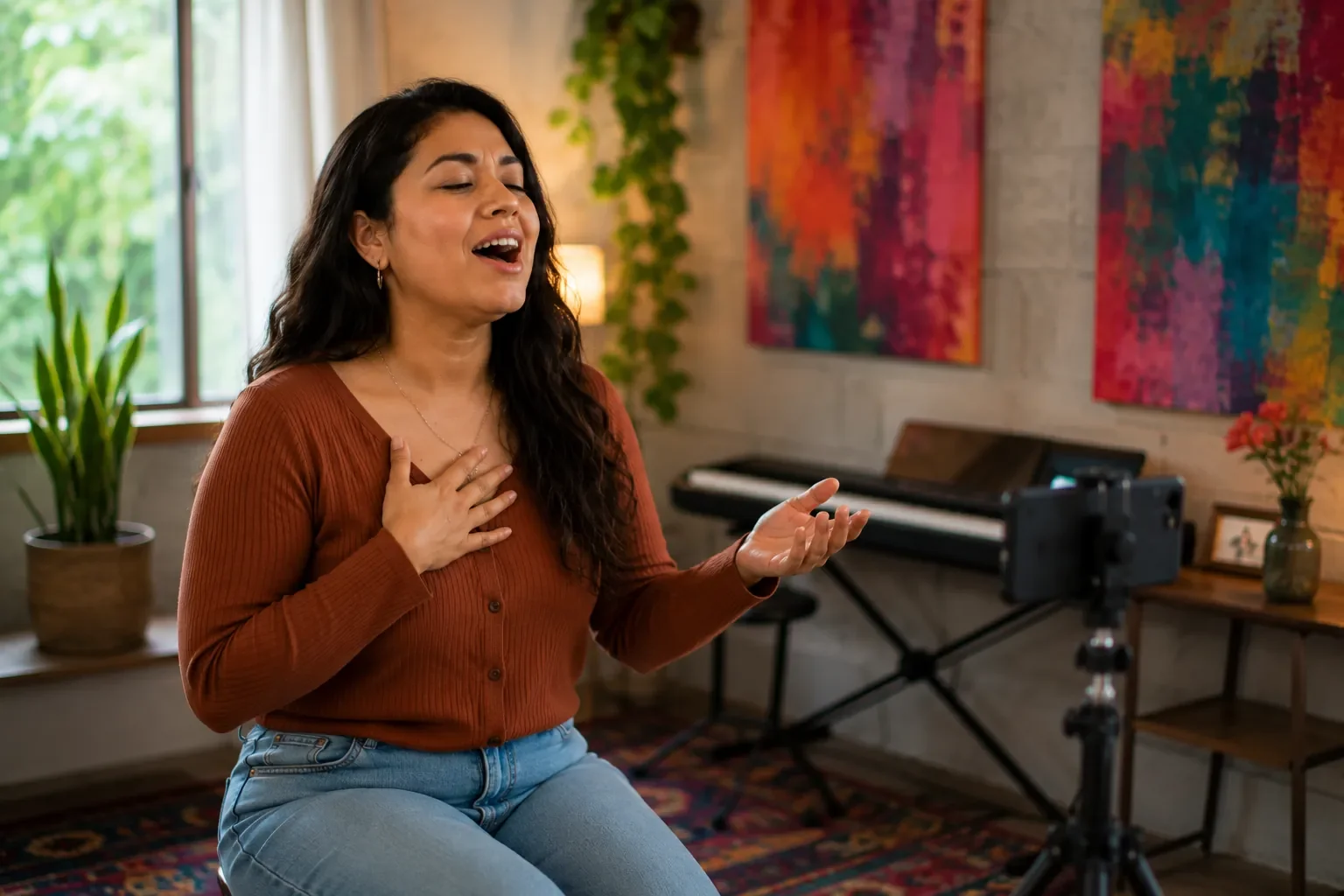
Most of the women I teach sing better than they think they do. The gap is rarely ability. It is the flinch — the held breath before a phrase, the apology right after it, the volume that never quite commits. After 25 years of coaching, I can tell you the flinch is trainable, the same way pitch is.
Below is my working list of what actually builds singing confidence: seven habits I give students in their first month, then a separate section on stage fright, because performing for people is a different problem from singing alone and needs its own tools.
The short version
Singing confidence is not a personality trait. It is four learnable skills — letting your voice out at real volume, exploring a sound without grading it mid-note, knowing how to warm up and reset, and staying inside the song rather than commentating on it. You build all four by making sessions small, frequent and forgiving. Most of my students feel noticeably steadier in four to six weeks. Stage fright is separate, physical, and handled with different tools: slow breathing, an overlearned first line, and graded exposure.
What singing confidence actually means
Not perfection, and not sounding professional. In my studio, confidence means four specific things.
| The skill | What it looks like | What it is not |
|---|---|---|
| Volume | You let the sound out at the size it wants to be | Singing loudly to prove something |
| Exploration | You can try a new sound without grading it mid-note | Never making an ugly noise |
| Recovery | You know how to warm up, and how to reset when something feels off | Nothing ever feeling off |
| Presence | You stay inside the song instead of hovering above it, commentating | Not caring how it sounds |
All four are skills. A shy person can learn them the way she could learn to drive. That matters, because most women who tell me they lack confidence believe they are missing a personality trait. They are missing reps.
1. Start smaller than you think you should
Do not open your comeback with the big chorus you loved at 25. Open with a hum at your speaking pitch, which for most women sits somewhere around G3 to B3. Hum, slide up a third, come back down. Add a lip trill. Sing one line of something easy at half volume.
This feels almost insultingly modest, and that is the point. Confidence is banked successes. A gentle hum you nail is worth more to your nervous system than a high note you scrape, because when the first sixty seconds of every session go well, your body starts predicting that singing goes well. Prediction is most of what we call confidence.
2. Build a warm-up you can run on autopilot
Anxiety feeds on open questions, and "what should I even practice?" is an open question. Close it. Pick a five to ten minute sequence and keep it identical for a month: two minutes of humming, two minutes of lip trills, a few five-note slides on "oo," then one verse of a song you know cold. My standard warm-up routine works as a starting template if you would rather not design one.
After a couple of weeks the routine itself becomes a signal of safety. Students tell me the first hum settles them before anything has technically happened. That is not magic. It is conditioning, and it works in your favor as long as you keep the routine boring and predictable. Save the novelty for repertoire.
3. Fix your posture before you blame your voice
A collapsed chest and locked knees restrict your breath. Restricted breath makes a shaky tone. A shaky tone convinces you that you cannot sing, when the actual culprit was how you were standing at the kitchen counter.
Try this before your next practice. Feet under your hips. Knees soft. Shoulders down, but not pinned back like a soldier. Back of the neck long, as if the crown of your head is being drawn gently up. Now sing the phrase you just sang slumped, and listen. Most people hear a steadier core in the sound on the first try.
There is also a feedback loop here that I find slightly unfair in our favor: it is very hard to feel timid while standing like someone who expects to be heard.
4. Practice without an imaginary audience
Plenty of singers perform even when the room is empty. They hear a judging listener who does not exist and shape every note for that ghost. The trouble is that you cannot experiment in front of an audience, real or imagined, and experimentation is the practice room's entire job.
So strip the ghost out on purpose. Face away from the mirror. Sing at half volume for a week. Practice when the house is empty, or tell your family the kitchen is a review-free zone from 8:00 to 8:10. These sessions train more than technique. You are practicing being unobserved, and that skill transfers.
Nobody hears it but you.
Vocal Refresh is a daily practice app for women returning to singing. No audience, no scores, no sharing; the audio never leaves your phone. A voice check sets your level and each session is five to twenty minutes. Join the waitlist and we email you the day it opens.
No spam. Leave any time.
Or start in private right now: the free vocal range test records nothing.
5. Separate the skill from your worth
A rough practice day is data, not a verdict. Voices are physical. Sleep, hormones, allergies, stress, hydration: all of it shows up in the sound, which means some days the instrument you pick up is simply not the one you put down yesterday.
We can be dissatisfied with a note. Never with a person.
That is the rule in my lessons. Borrow it. The singers who improve fastest are not the most talented ones I have taught. They are the ones who can shrug at a bad Tuesday and show up Wednesday. If you want the longer argument for what regular singing gives a woman beyond the sound itself, I made that case in what actually happens when you sing.
6. Sing songs that fit the voice you have today
Repertoire is a confidence decision. A song that sits in your comfortable range frees you to think about meaning and phrasing. A song a third too high turns every chorus into survival, and your body quietly files the whole experience under threat.
So choose kindly. If the original key is too high, drop it. Professionals transpose constantly; taking "Landslide" down two semitones is standard practice, not an admission of defeat. It helps to know where your range actually sits before you pick, rather than after. Keep one reach song on the side as a goal for a few months out, and be honest with yourself that it is a goal, not tonight's material.
7. Make singing a habit, not an event
Ten minutes most days beats an hour on Sunday, and it is not close. Rare singing is high-stakes singing: each session carries the weight of proving something. Frequent singing is low-stakes by definition, and low stakes are the conditions under which voices relax and improve.
Attach practice to something that already happens daily. The kettle, the commute, the shower. Mothers of small children have the hardest version of this problem, which is why I wrote a separate guide to practicing when the house is never empty, built entirely around ninety-second scraps of time.
One more habit worth building: sing with other people when you can, even once a month. A room full of voices lowers the stakes for yours, and the benefits of group singing go well beyond cover.
Stage fright is a different problem, so treat it differently
Everything above builds practice-room confidence. Performing adds a second system: adrenaline. Dry mouth, shaky knees, a heart doing double time. Your body has decided the choir solo is a predator, and you cannot talk it out of that in the moment. You can, however, work around it.
First, some reassurance about how ordinary this is. In a survey of professional musicians playing in Dutch symphony orchestras, 58.7 percent reported experiencing music performance anxiety; among Japanese classical musicians the figure was 63.9 percent.1 These are people who perform for a living. If your knees shake before a solo, you are in the majority of professionals, not the minority of amateurs.
Here is the toolkit, in the order I hand it to students.
- 10 min beforeLengthen your exhale. Breathe in for four counts and out for eight. That is five breaths a minute, inside the range where slow breathing reliably shifts the nervous system toward its parasympathetic, calm-down side.2 Nobody watching will know you are doing anything at all.
- In rehearsalOverlearn your first line. Fright hits hardest in the opening seconds, so drill the first phrase until it runs without you. Once you are two lines in, the body usually settles on its own.
- In rehearsalRehearse the boring parts. The walk to the front, the nod to the accompanist, the first breath. Most singers rehearse the song and improvise the entrance, which is backwards — the entrance is where the panic lives.
- Over weeksClimb a ladder, not a cliff. Record a voice memo. Sing for one kind friend. Then a small group, then the solo. Each rung teaches your body that being heard is survivable, and the lesson compounds.
- 30 sec beforeRename the feeling. Say "I am excited" out loud. See below — this one has better evidence behind it than it has any right to.
Why "I am excited" beats "I am calm"
The last item on that list sounds like a slogan. It is the best-evidenced thing on the page.
Alison Wood Brooks, at Harvard Business School, had people sing "Don't Stop Believin'" into a karaoke game that scored them on pitch, volume and timing. Before singing, each person said one sentence out loud. Those who said "I am excited" scored 80.5 percent accuracy. Those who said "I am anxious" scored 53.0 percent. People who said nothing at all landed in between, at 69.3 percent.3
That is a 27-point swing from one sentence. The mechanism is straightforward: anxiety and excitement are the same physiological state — high arousal — and trying to talk yourself down to calm is a long way to travel. Relabeling sideways, from threat to opportunity, is a much shorter trip, and your body will accept it.
So do not tell yourself to relax before you sing. Tell yourself you are excited, out loud, and mean it as an observation rather than a wish.
On the days it all evaporates
You will have days when the voice feels foreign and every bit of confidence you have built seems gone. This is normal and it is temporary. Shrink the session instead of skipping it: hum one song while you empty the dishwasher and call it done.
What you are protecting on those days is not progress. It is the thread of the habit, and the habit is what everything else hangs from.
If you want the structure handed to you, this is exactly what I built the Vocal Refresh app for: short daily routines, gentle confidence work, and a plan that assumes you have a real life. You do not need to feel confident before you start. The confidence comes out of the practice, one small and forgiving step at a time.
Sources. 1. Irie, N., Morijiri, Y., & Yoshie, M. (2023). Symptoms of and coping strategies for music performance anxiety through different time periods. Frontiers in Psychology. 2. Zaccaro, A., et al. (2018). How breath-control can change your life: a systematic review on psycho-physiological correlates of slow breathing. Frontiers in Human Neuroscience. 3. Brooks, A. W. (2014). Get excited: reappraising pre-performance anxiety as excitement. Journal of Experimental Psychology: General, 143(3), 1144–1158.
Frequently asked questions
What is confidence in singing?
It is four learnable skills, not a personality trait: letting your voice out at real volume, exploring a new sound without grading it mid-note, knowing how to warm up and reset when something feels off, and staying inside the song rather than hovering above it commentating. Confidence is not the absence of nerves or the presence of talent. It is accumulated evidence that singing usually goes fine, which is why small frequent sessions build it faster than rare ambitious ones.
How do I build singing confidence?
Make the sessions small, frequent and forgiving. Start each one below your ability so the first sixty seconds go well, run the same warm-up daily until it is automatic, sing songs that sit in your comfortable range rather than a key that turns every chorus into survival, and practice in a genuinely unobserved setting so you can experiment. Ten minutes most days beats an hour on Sunday, because rare singing is high-stakes singing.
How do I get over stage fright when singing?
Work with the adrenaline instead of fighting it. Slow your exhale before you perform, breathing in for four counts and out for eight, which puts you around five breaths a minute where slow breathing shifts the nervous system toward its calming side. Overlearn your opening line so it runs on autopilot. Say "I am excited" out loud rather than trying to calm down. Then build exposure gradually: record yourself, sing for one friend, then a small group. Stage fright shrinks with repetitions, not with waiting until you feel ready.
Is singing 90 percent mental?
No, but the mental part is larger than most beginners expect and much larger than most technique-focused teaching admits. Singing is a physical skill with real mechanics, and no amount of positive thinking will build breath support or a smooth register transition. What confidence does is remove the interference: nervousness shortens the breath, raises the larynx and tightens the jaw, so an anxious singer performs well below her own technical ceiling. Think of it as technique setting the ceiling and confidence determining how close to it you get on the day.
Why am I confident singing alone but not in front of people?
Because they are different skills. Singing alone tests coordination; singing for people adds adrenaline and the fear of judgment, which tighten the breath and throat. The fix is graded exposure: perform for progressively larger, kinder audiences so your body learns the situation is safe. It is also far more common than it feels — in one survey, 58.7 percent of professional orchestral musicians reported music performance anxiety. Needing many low-stakes repetitions is typical, not a flaw.
How long does it take to build singing confidence?
Most of my students feel noticeably steadier within four to six weeks of short, near-daily practice, because confidence tracks familiarity. Performance confidence takes longer, usually a few months of gradually increasing exposure. The timeline shortens when sessions are small and frequent, and it stretches when singing stays a rare, high-stakes event.
Does confidence actually change how your voice sounds?
Yes, audibly, and there is a number on it. In a Harvard study, singers who said "I am excited" before performing scored 80.5 percent on a pitch, volume and timing measure, against 53.0 percent for those who said "I am anxious" — the same people, the same song. Nervousness shortens the breath, raises the larynx and tightens the jaw, which makes tone thin and pitch unstable. A singer who feels safe breathes lower and lets the sound resonate, so the same voice comes out fuller and steadier.
What if someone told me I can't sing?
One careless comment, often decades old, does more damage than any technical fault I see in my studio. Almost everyone can learn to match pitch and carry a song; true tone deafness is rare, affecting around 1.5 percent of people. Treat the old comment as outdated information about an untrained voice, start with gentle daily humming, and let recordings of your progress replace the memory. I have written more on whether anyone can learn to sing, at any age.