
Free Vocal Range Test
Sing three notes and see your range, your voice type and where your voice sits on the piano. About two minutes.
Sing three notes, about two minutes
Your lowest note, your highest, then the highest note that still feels comfortable. Sing an open “ah” and hold each one steady. Nothing is recorded — detection happens on your device.
Prefer to explore first? (an example, not your voice)
Slide down to the lowest note you can hold steady in chest voice. Stop before it rattles.
Slide up to the highest note you can hold. Falsetto counts, and we say where it starts.
Last one. The highest note you could sing over and over in a song, without pushing. Most people land three to six notes below the note they just reached.
Play the reference tones and pick the lowest and highest notes you can match.
Play each note and move the slider until it matches what you can sing.
Keep it, and everything that comes with it
Add your email and we send your snapshot: your range, your voice type and the singer whose range matches yours, plus a short warm-up built for those two notes. This also puts you on the Vocal Refresh waitlist.
- Your shareable card, as a download
- The singer whose range matches yours
- Songs that sit inside your range
- Take the test as often as you like to see progress
This adds you to the Vocal Refresh waitlist. We’ll email your results so you can track progress over time.
You’re on the list. Your range is right below, and the rest is in your inbox. See it
How to use the vocal range tester
- Slide down to the lowest note you can hold steady in chest voice. Stop before it rattles.
- Slide up to the highest note you can hold, falsetto included.
- Find your comfortable ceiling: the highest note you could sing over and over in a song without pushing. That note sets your voice type.
- Read the two notes. The span between them is your range, in note names and in octaves.
- Test again in a month, at the same time of day. Morning voice and evening voice are not the same voice.
A vocal range test online, right in your browser
Nothing to install, no app to hunt for. Open this page on your phone, laptop or tablet, allow the microphone, and sing. That’s the whole setup.
The mic listens for pitch, live, on your device. No audio is recorded or sent anywhere. If your browser won’t open the microphone, switch to the by-ear option and match the reference tones instead.
“Vocal test” can mean a lot of things. This one measures range: your lowest note, your highest note, and the note where your voice is comfortable. Three notes, about two minutes.
Using it as a vocal range finder
A range finder answers one question. Where does your voice start, and where does it stop? Sing down until the tone turns creaky and stop a note above that. Then sing up until it thins out or starts to pinch, and stop there too. Hold each note steady for a moment and the test locks it for you, so you never have to work out note names yourself.
Already know your two notes from a piano, a choir director or an old lesson? Skip the mic. Put them into the vocal range calculator and you get the same chart and the same voice types without singing a note.
How to find your vocal range with a piano, or without one
The test does this for you in about two minutes. Want to do it yourself? Here’s the by-hand version. Give it ten minutes and a pencil.
- Warm up. Hum gently for a minute or two. A cold voice comes up short at the top.
- Find middle C. On a piano it’s the C nearest the middle of the keyboard, written C4. No piano? The free pitch pipe plays every note from octave 3 up to octave 5 on your phone.
- Walk down one key at a time. Match each note on an open “ah”. Stop at the last note you can hold for a couple of seconds with real tone. Creaky or breathy doesn’t count. Write it down.
- Go back to C4 and climb. Head voice and falsetto count. Stop at the last note you can hold without squeezing, and write that one down too.
- Put the two notes together. G3 to E5, say. That’s your range. One thing trips people up: the number changes at C, so the note after B3 is C4.
Then look your two notes up in the chart below, or drop them into the calculator for your range in octaves and your voice type.
The hard part by hand is knowing whether you’re actually on the note. Not sure? That’s the job the test does. It listens and tells you.
Vocal range chart
Every voice type, with the note range and octave span each one typically covers.
| Voice type | Typical range | Octave span | Known for |
|---|---|---|---|
| Soprano | C4 – C6 | 2 octaves | Highest women’s voice; bright and agile above the staff |
| Mezzo-soprano | A3 – A5 | 2 octaves | The most common women’s voice; warm through the middle |
| Contralto (Alto) | F3 – F5 | 2 octaves | Lowest women’s voice; rich and dark, and rare |
| Tenor | C3 – C5 | 2 octaves | Highest common men’s voice; bright at the top |
| Baritone | A2 – A4 | 2 octaves | The most common men’s voice; warm through the middle |
| Bass | E2 – E4 | 2 octaves | Deepest men’s voice; the least common of the six |
Ranges overlap on purpose. Voice type is about where your voice is comfortable and how it sounds, not only about the notes you can reach.
The full picture on a keyboard
Every voice type, women’s and men’s, mapped onto the piano so you can see how they overlap.
Where you standIs your range good? Here is where you actually stand
Almost everyone asks this, so here is a straight answer. An untrained adult voice usually measures about 1.5 to 2 octaves. A regular singer with some training lands around 2 to 2.5. Trained and professional voices run 3 octaves and up.
Two octaves covers the overwhelming majority of popular music. You do not need more than that to sing almost anything you actually want to sing.
One number worth ignoring: the five and six octave claims attached to famous singers. Those usually count whistle tones, vocal fry, and notes nobody would ever perform. Measured the way this test measures, the gap between you and a professional is a lot smaller than the internet suggests.
If you tested lower than you expected, the usual culprits are a cold voice, a noisy room, and counting notes you cannot actually hold. Warm up and test again on a different day.
Tips for best results
🔇Find a quiet room
Background noise confuses pitch detection. A calm, echo-free space gives the cleanest read.
🌡️Warm up first
Hum gently for a minute. A cold voice under-reports your true range, especially up top.
🎵Sing on “ah” or hum
Steady open vowels track better than words. Hold each note for a second or two before locking.
🚫Skip the vocal fry
Only count notes you can sing cleanly with tone. Creaky fry gives false lows the mic can’t read.
📱Get close to the mic
A few inches away, pointed at your mouth. Earbuds with a mic work well too.
📅Re-test on different days
Range shifts with sleep, hydration and time of day. Test a few times for your real picture.
Troubleshooting common issues
🎤The mic won’t connect
Check your browser’s site permissions and allow microphone access, then reload. On iPhone, use Safari and confirm the mic isn’t muted. No luck? Use the test-by-ear option.
🔢The note keeps jumping
Usually background noise or fry. Move somewhere quieter, sing a steady “ah,” and hold the note for a second so the reading settles before you lock it.
⬇️My low note reads too high
You may be slipping into vocal fry, which the mic ignores. Only count the lowest note with real tone behind it.
⬆️I can’t reach my old high notes
Normal after a break. Warm up gently and don’t push. Your ceiling comes back with consistent practice, which is exactly what Vocal Refresh builds.
🤫It’s not picking up my voice
Sing a little louder and move closer to the mic. Watch the level bar. If it barely moves, your input device may be wrong in system settings.
📊My result looks different each time
That’s expected. Range varies daily. Test after a warm-up, a few times across the week, and take the widest clean reading.
🎶My voice cracks in the middle
That is your passaggio, and it is normal. Voice cracks in adults explains why it happens and how to smooth it.
Female voice types: soprano, mezzo, alto
Voice type is about more than range, but range is the best place to start. Voice type is where your range sits, not how good it sounds; two people with the same two notes can be typed differently depending on where the voice is comfortable. Here’s where the three main women’s voices sit, with famous singers in each.
🕊️Soprano
Approx. C4 – C6 (and up). The highest women’s voice: bright, agile, and ringing up top. Comfortable soaring above the staff.
Mariah Carey, Ariana Grande, Whitney Houston, Céline Dion, Christina Aguilera.
🎯Mezzo-soprano
Approx. A3 – A5. The most common women’s voice: warm, full and versatile through the middle. The pop powerhouse zone.
Adele, Beyoncé, Lady Gaga, Taylor Swift, Alicia Keys, P!nk.
🌙Contralto (Alto)
Approx. F3 – F5. The lowest and darkest women’s voice: rich, smoky and resonant in the low end. Rare and striking.
Cher, Amy Winehouse, Lana Del Rey, Toni Braxton, Annie Lennox.
Names show where a voice sits, not what to aim at. Check your own two notes first, then read the row they land in.
How the label is chosenVoice type test: what your result means
Your voice type comes from the third note you sing, the comfortable one. The highest note you can reach tells you your ceiling. The comfortable note tells you where your voice actually lives, and that’s the better guide to type.
The cutoffs are simple. A comfortable top of F5 or higher reads soprano. G4 up to E5 reads mezzo-soprano. Below G4 reads contralto. Your result shows the highest note you reached as well, so both numbers sit side by side.
Tested by ear? Then there’s no comfortable note to read, and the type comes from your two notes instead.
Time away from singing can pull that comfortable note down. Read the label as today’s answer and test again later. Want a second opinion without the mic? The voice type test works from two notes or six questions.
Your range and your comfortable range are two different numbers
The test gives you a floor and a ceiling. That is not the number you sing with.
Your tessitura is the stretch in the middle where your voice sits without effort. It is usually narrower than your full range by three or four notes at each end, and it is the honest answer to the question “what can I actually sing?” The top three notes of your range are notes you can reach. They are not notes you can hold through a chorus.
Most women coming back after a break test wider than they expect and sing narrower than they expect. That gap is normal, and it closes with practice.
To find yours: sing a familiar song in a comfortable key and notice where you stop thinking about your voice. That band is your tessitura. Pick songs that live there and you will sound better immediately, without changing a single thing about your technique.
Men’s voice types, briefly
Vocal Refresh is built for women, and everything above is written for women’s voices. But range is range, and the keyboard already maps all six. The test measures your range the same way; the voice type it names is drawn from the three female classifications, so read the chart rather than the label. If your lowest note is B2 or below, the result also names the lower voice type it matches and adds tenor, baritone and bass to your chart.
🎺Tenor, C3 to C5. The highest common men’s voice, bright and ringing at the top. Freddie Mercury, Bruno Mars, Stevie Wonder.
🎷Baritone, A2 to A4. The most common men’s voice, warm and easy through the middle. Frank Sinatra, John Legend, Hozier.
🎻Bass, E2 to E4. The deepest and the least common. Barry White, and Johnny Cash down at the bottom of his range.
Same rules as everywhere else on this page: test warm, ignore vocal fry, and count only the notes you can hold cleanly.
Which songs can you sing right now?
Take the test and your own list appears with your result — songs whose chorus sits inside your comfortable range, plus the ones you can reach by transposing down a step or two. Start the test.
Once you have your range, song choice stops being guesswork. Look at the highest note in the chorus, not the highest note in the song. Choruses repeat, and repetition is where voices give out. If the chorus peak sits inside your comfortable range with two notes to spare, the song fits you.
If it is close but not quite, transpose it. Dropping a song two or three semitones is standard practice, not cheating. Every professional singer performs in their own keys.
Some rough starting points. Sopranos: most contemporary pop sits comfortably. Mezzos: Adele, Sara Bareilles, and most musical theatre belt repertoire. Contraltos: Lana Del Rey, Amy Winehouse, and anything written low and slow.
If a song leaves you reaching on every chorus, that is not a sign you need to work harder. It is the wrong key.
More free tools for your voice
Frequently asked questions
How does the vocal range test work?
It uses your device’s microphone to analyze the pitch of your lowest and highest comfortable notes in real time, then maps them to a note range and octave span. Everything runs live on your device. Nothing is recorded or uploaded.
Do I need any special equipment?
No. Any device with a microphone works: phone, laptop or tablet. Earbuds with a built-in mic are perfect. No mic at all? Use the test-by-ear option with our reference tones.
Should I include falsetto or head voice? What about vocal fry?
Include head voice and falsetto. Those are real, usable notes, and we name where falsetto starts. Exclude vocal fry: it produces creaky overtones that confuse the mic and give a false low reading. Only count notes you can sing with actual tone.
What does my vocal range tell me about my voice type?
Range is a strong clue, but true voice type also depends on vocal weight, tone color and where your register transitions sit (your tessitura). Use your result as a friendly starting point, not a final verdict. Full explainer.
How accurate is an online vocal range test?
Very usable for everyday singers. We average multiple pitch readings while you hold each note for consistency. For a formal classification, a vocal coach who can hear your tone and weight is the gold standard.
Can I trust a single result?
Treat one test as a snapshot, not a verdict. Range shifts with time of day, hydration, sleep, health and warm-up. Test a few times across the week and take the widest clean reading.
Why did my range change since last time?
Time of day, sleep, hydration and how recently you spoke all move it. That is normal, and it is the reason to re-test at a consistent hour.
I can hit a note, but it sounds bad. Should I count it?
For your usable range, count notes you can sing with good tone and breath support, without strain. The squeaky edges are worth knowing about, but they’re not where you’ll actually sing.
How can I expand my vocal range?
Gradually and gently, with consistent, range-appropriate warm-ups, breath support and exercises that smooth your register transitions. Pushing for high notes cold does more harm than good. That steady, safe expansion is exactly what a Vocal Refresh plan is built around.
Will I get to keep my results?
Yes. We email your snapshot so you can save it and re-test later to watch your range grow over time.
Is my voice private?
Completely. Pitch detection happens on your device in the moment. No audio is recorded, stored or sent anywhere. Nobody hears you but you.
Can I check my vocal range without signing up?
Taking the test needs no account, and nothing is recorded. Seeing your results does need an email address: sing three notes, then add your email and we send your full snapshot, your range, your voice type and the singer whose range matches yours. That also puts you on the Vocal Refresh waitlist.
Is this a female vocal range test?
It works for any voice, but it was built for women’s voices first. Your result names the female voice types (soprano, mezzo-soprano, contralto) and matches your range to female singers who share it. Men get an accurate range reading too, since the note names and octave span are the same for any voice, but the voice type it names will be one of the three female classifications. The chart further up the page covers tenor, baritone and bass.
Is this a voice range test or a vocal range test?
Both names describe the same thing, and this page is both. Some people search for a voice range test and some for a vocal range test; either way you sing three notes and get your lowest note, your highest note and the voice type that matches. If you came looking for a voice type test, the result names that too.
Is there a pitch test too?
Yes. The pitch test checks how accurately you hit a note, which is a different question from how wide your range is. It plays a note, you sing it back, and it scores how close you landed, in about two minutes. The two results pages link to each other.
Can I take a vocal range test online without downloading an app?
Yes. It runs in your browser on a phone, laptop or tablet. Allow the microphone, sing three notes, and the pitch is read live on your device. Nothing is installed and nothing is recorded. If the microphone won’t open, the by-ear option works without it.
Is this the same as a vocal range finder?
Yes. A range finder and a range test do the same job: they find your lowest and highest notes. This one also reads a comfortable note, and that’s the note it uses to name your voice type. Already know your two notes? The vocal range calculator gives you the same result without singing.
How does the voice type test decide soprano, mezzo or contralto?
It reads your comfortable top note. F5 or higher reads soprano, G4 up to E5 reads mezzo-soprano, and below G4 reads contralto. If you test by ear, it uses your two notes instead. Range is only part of voice type, so take the label as a starting point.
How do I find my vocal range with a piano?
Warm up, then start at middle C (C4). Sing down one key at a time and write down the last note you can hold with real tone. Go back to C4 and climb the same way, head voice included. Those two notes are your range. No piano? The free pitch pipe plays every note from octave 3 to octave 5.
Articles to help you sing stronger
Hand-picked reads on warming up, breathing, your range, and keeping your voice healthy. Warm up before you test with the free warm-up routine builder: pick five to twenty minutes and it runs the exercises with a timer and reference tones.

Vocal Range Explained: Voice Types, Octaves & the Range Chart
Make sense of your result: voice types, octaves, and what actually decides your range.
Read →
5-Minute Vocal Warm-Ups: The Complete Guide for Returning Singers
The exact warm-ups to run before you test, and before every session, to sing safely.
Read →
How to Sing From Your Diaphragm: A Step-by-Step Guide
Breath support in five steps: the engine behind steady notes and stamina.
Read →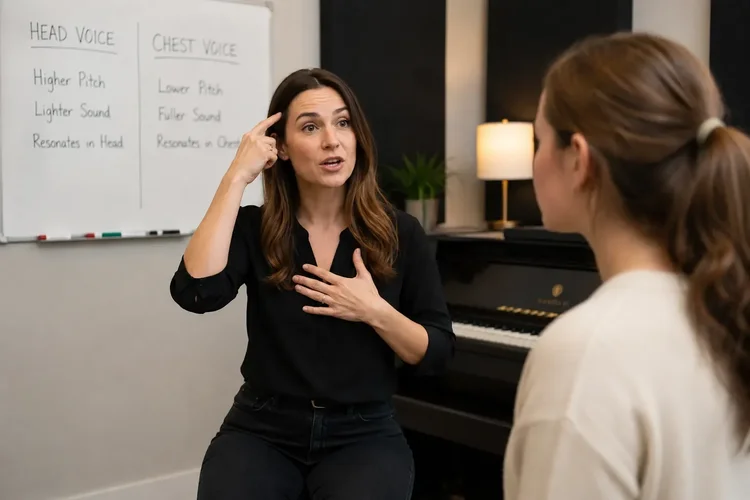
Head Voice vs. Chest Voice Explained for Women
Know your two registers, and smooth the break in the middle of your range.
Read →
How to Sing Better: 12 Ways to Improve Your Singing Voice
Twelve practical techniques, from breath to song choice, to grow your voice.
Read →
The Aging Female Voice: What Changes & How to Keep Singing Strong
How your voice shifts over time, and how to keep it healthy and strong.
Read →Turn your range into a plan
Vocal Refresh opens to founding members first, at $69.99 a year held for three years. That price is our thanks for backing it before it shipped. iOS at launch, with a free tier and a 14-day trial of the paid plan. Free to join. Nothing is charged today.
Free to join. Founding members pay $69.99 a year, held for three years.