Vocal Range Chart: Find Your Voice Type at Home
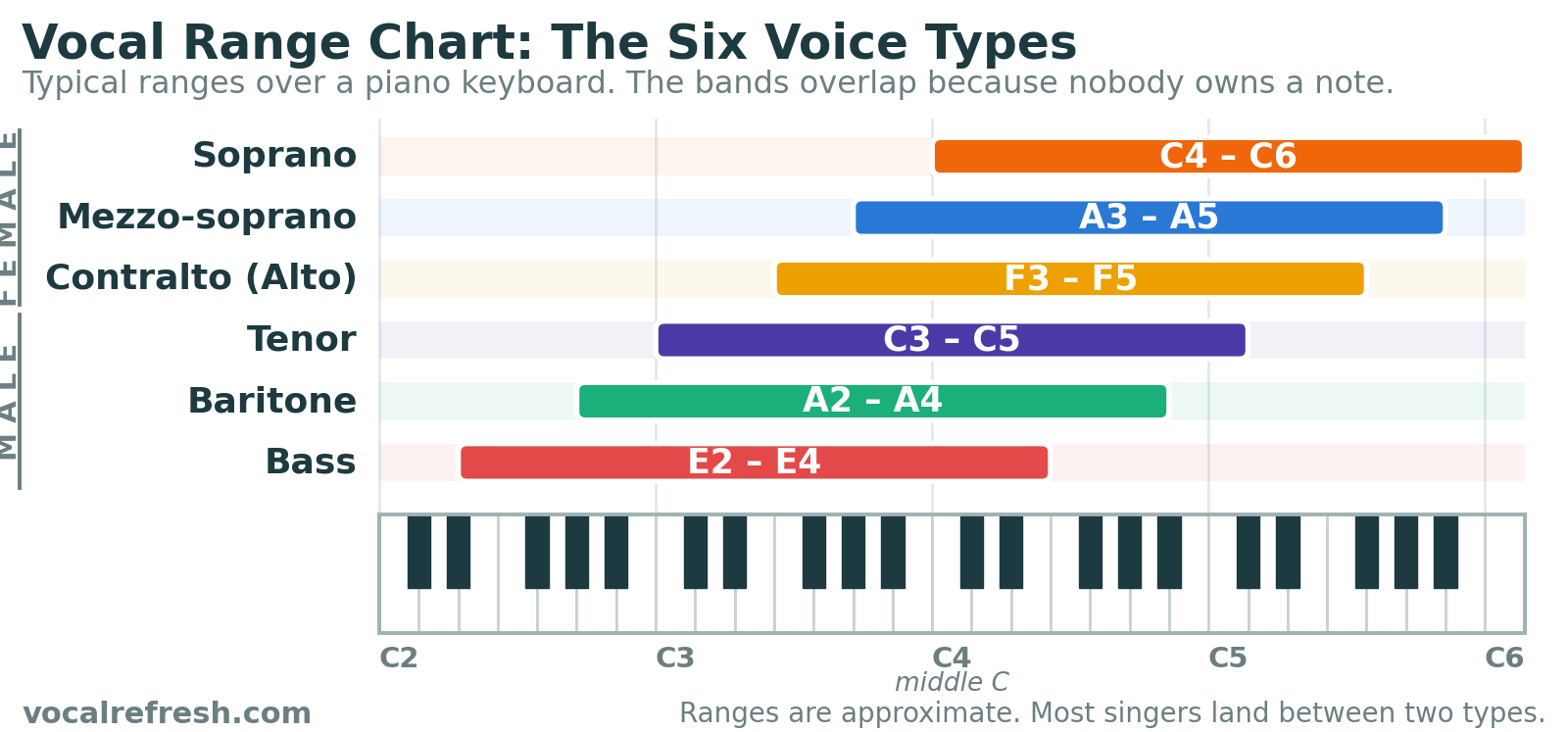
The six voice types over a piano keyboard. Most singers straddle two of these bands, not one.
The six bands above: soprano C4–C6 · mezzo-soprano A3–A5 · contralto (alto) F3–F5 · tenor C3–C5 · baritone A2–A4 · bass E2–E4. Approximate, and they overlap.
Not sure those two notes are really yours?
Sing three notes and the test finds them for you — one that feels easy, then your lowest, then your highest. Hum or sing them. Nothing is recorded or saved.
Your result and a plan for your voice come by email after the test.
Look up your own two notes
Pick the lowest and highest note you can sing cleanly. Not whispered, not shouted. You get the same read the test gives, using female voice-type thresholds.
Reading about your range is one thing. Singing it settles it. The test takes about two minutes.
Not sure those two notes are really yours?
Sing three notes and the test finds them for you — one that feels easy, then your lowest, then your highest. Hum or sing them. Nothing is recorded or saved.
Your result and a plan for your voice come by email after the test.
Ask five singers what their vocal range is and you will get five confident answers, and at least three will be wrong. Not because anyone is a bad singer, but because "vocal range" gets used loosely. Strictly, your range is the distance between the lowest note you can sing cleanly and the highest, written as two notes with octave numbers, like G3 to E5.
Quick answers
Is E5 a high note? For a woman, E5 is the top of the mezzo-soprano band and a normal ceiling for an adult voice. F5 and above reads soprano.
Is G3 a low note? Not for a female voice. G3 sits inside both the contralto and mezzo ranges, and it is where most women coming back to singing find their floor.
What does a range of G3 to E5 mean? 21 semitones, a little under two octaves. On the female thresholds it reads mezzo-soprano.
What about A3 to C5? 15 semitones, about 1¼ octaves. Mezzo-soprano, and a perfectly ordinary place to start.
Is A5 higher than E5? Yes, by five semitones.
This is the theory side: what those letters and numbers mean, the six classic voice types, how to read a vocal range chart without forcing yourself into the wrong box, and why something called tessitura matters more than your top note ever will. You can measure yours right below with the built-in test, read the theory first and sing after, or use the step-by-step piano method further down.
The short answer
A vocal range is the span from your lowest clean note to your highest, like G3 to E5. The free vocal range test finds yours in about two minutes. Most charts sort those spans into six voice types. Female: soprano C4–C6, mezzo-soprano A3–A5, contralto (alto) F3–F5. Male: tenor C3–C5, baritone A2–A4, bass E2–E4. Most untrained adults have an octave and a half to two octaves, and land somewhere between two types rather than squarely inside one.
How is a vocal range written down?
Every note has a letter name, A through G, and a number telling you which octave it sits in. Middle C, the white key in the middle of a piano, is C4. The A just below it is A3, and the C an octave higher is C5. So a range of G3 to E5 means the lowest clean note is the G below middle C and the highest is the E almost two octaves above it.
You can measure the span between those notes in octaves or in semitones. A semitone is the step from one piano key to its neighbor, black keys included, and twelve of them make an octave. G3 to E5 works out to 21 semitones, a little under two octaves.
Most untrained adults have somewhere between an octave and a half and two octaves of comfortable range. In my studio, women coming back after years away usually land around G3 to C5 on day one, which is a perfectly respectable place to start.
What are the six voice types?
Voice types are labels for the neighborhood your range sits in, nothing more. They come from classical music, where composers needed to know which singers could cover which parts, and choirs still use them for sorting. Three are conventionally female and three conventionally male, though the ranges overlap far more than the labels suggest.
The three female voice types
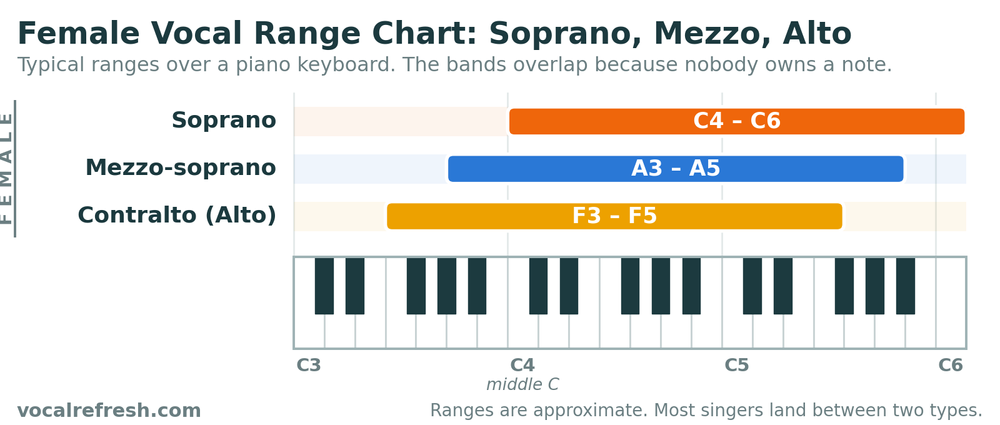
| Voice type | Typical range | Where it sits |
|---|---|---|
| Soprano | C4 to C6 | The highest common female voice; bright and clear on top |
| Mezzo-soprano | A3 to A5 | The female middle, and the most common women's voice |
| Contralto (alto) | F3 to F5 | The lowest common female voice; warm and full underneath |
The three male voice types
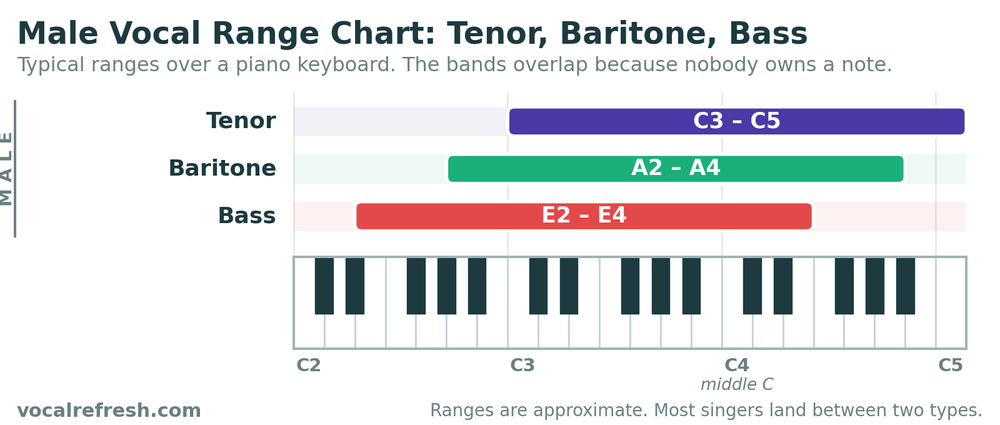
| Voice type | Typical range | Where it sits |
|---|---|---|
| Tenor | C3 to C5 | The highest common male voice |
| Baritone | A2 to A4 | The male middle, and the most common men's voice |
| Bass | E2 to E4 | The lowest common male voice |
Two warnings about those numbers. They are approximate, and you will see charts that stretch baritone down to G2 or soprano up to F6 — nobody has ever agreed on the borders, because real voices ignore them constantly. And choir labels are the least reliable of all: plenty of women singing alto in a community choir are actually mezzos who happened to read harmony well, because that is how directors fill sections. If someone parked you on the alto bench in 1998, that was a seating decision, not a diagnosis. If you want a second opinion, the voice type test takes two notes or six questions.
How do you read a vocal range chart?
A vocal range chart lays those six ranges over a piano keyboard as overlapping bands. The overlap is the point. A mezzo shares her top octave with sopranos and her bottom octave with contraltos; nobody owns a note.
To use one, find your lowest and highest notes on the keyboard and see which band your span mostly falls inside. Do not expect a tidy fit. Landing between two types is normal, and honestly more common than landing squarely in one. A woman sitting at A3 to D5 is arguably a low mezzo and arguably a high contralto, and the honest answer is that the label does not change a single thing she should practice tomorrow.
What matters more than your two endpoints is where your comfortable notes cluster, which brings us to tessitura. It is also worth knowing that a chart maps pitches, not registers — the shift you feel partway up is your passaggio, and the difference between head voice and chest voice explains what is happening there.
Why do some charts show seven voice types, or only four?
Because different traditions count differently, and none of them is wrong.
- Six is the standard classical set: soprano, mezzo-soprano, contralto, tenor, baritone, bass. This is the one most range charts use.
- Seven usually means someone has added the countertenor, a male voice trained to sing in the alto or soprano range, roughly G3 to E5. It is a rare voice and a specialist skill rather than a common category.
- Four is choral shorthand: soprano, alto, tenor, bass, the four parts most written music is arranged for. SATB is about which line you sing in a piece, not about the voice you were born with. A mezzo will usually be given the soprano or the alto line depending on what the choir needs that season.
Opera goes further still and subdivides each type by weight and color — lyric soprano, dramatic soprano, coloratura and so on. Useful if you are being cast in La Traviata. Not useful if you are trying to work out whether you can sing a Carole King song in the original key.
Sing three notes. See where your voice sits today.
One note that feels easy, then your lowest, then your highest. Hum or sing them. Nothing is recorded or saved.
Your result and a plan for your voice come by email after the test.
Already know your lowest and highest notes? Type them into the free vocal range calculator and skip the mic.
How do you find your vocal range at home?
You need a piano, a keyboard app, or a tuner, plus about five minutes. Warm up first, because a cold voice will under-report at both ends; my five-minute warm-up routine is enough.
1. Find your floor
Start on a comfortable note near the middle of your voice and sing down a scale, one note at a time, on an "ah". Stop at the last note that still comes out cleanly — not whispered, not growled, not disappearing into air. That note is your floor. Write down its letter and octave number.
2. Find your ceiling
Come back to that comfortable middle note and slide upward the same way. Stop at the last note you can sing without straining, squeezing, or going hoarse. Shouting a note higher does not extend your range; it just makes your throat sore. That note is your ceiling.
3. Write it as a span and check the chart
Your range is those two notes with a "to" between them: F3 to A5, say. Count the octaves between them, then look at where that span sits against the six types above. If it straddles two, you straddle two, and that is a perfectly normal result.
One rule while you are counting: only reliable notes count. The E5 you hit once in the shower at full volume is not in your range until you can sing it on an ordinary Tuesday, at medium volume, on purpose. Measure twice on different days if the number surprises you; voices vary with sleep, hydration and the time of day, and mornings almost always read low.
What does a range like G3 to E5 mean?
A lot of readers arrive here with two notes already in hand, from a piano, an app, or our test above. What they want is the verdict. Here it is for the spans women look up most often. The voice-type calls below use the same female thresholds as our vocal range test: a dependable top note of F5 or higher reads soprano, B4 up through E5 reads mezzo-soprano, and below B4 reads contralto. Hold the result loosely — two endpoints are a snapshot, and the tessitura section further down explains why where your voice feels easy matters more than where it stops.
Vocal range chart — look up your two notes
Find your lowest and highest note below, or the closest row to it. Semitone counts are exact; the voice-type call uses the same thresholds as our vocal range test. The female column is the main read for this article — the male column is the equivalent call for men, since a good share of readers arrive here with a lower pair of notes. Two endpoints are a snapshot, so treat the type as a starting point rather than a verdict.
| Your range | Semitones | Octaves | Female voice type | Male voice type |
|---|---|---|---|---|
| E2 to A4 (e2–a4) | 29 | 2⅓ | — | Tenor |
| A2 to C5 (a2–c5) | 27 | 2¼ | — | Tenor |
| A2 to A4 (a2–a4) | 24 | 2 | — | Baritone |
| C3 to C5 (c3–c5) | 24 | 2 | Contralto | Tenor |
| C3 to E5 (c3–e5) | 28 | 2⅓ | Mezzo-soprano | Tenor |
| F3 to C5 (f3–c5) | 19 | 1½ | Contralto | — |
| F3 to E5 (f3–e5) | 23 | 1¾ | Mezzo-soprano | — |
| F3 to F5 (f3–f5) | 24 | 2 | Soprano | — |
| F3 to A5 (f3–a5) | 28 | 2⅓ | Soprano | — |
| F3 to C6 (f3–c6) | 31 | 2½ | Soprano | — |
| G3 to A4 (g3–a4) | 14 | 1¼ | Contralto | — |
| G3 to C5 (g3–c5) | 17 | 1½ | Mezzo-soprano | — |
| G3 to D5 (g3–d5) | 19 | 1½ | Mezzo-soprano | — |
| G3 to E5 (g3–e5) | 21 | 1¾ | Mezzo-soprano | — |
| G3 to F5 (g3–f5) | 22 | 1¾ | Soprano | — |
| G3 to A5 (g3–a5) | 26 | 2¼ | Soprano | — |
| G3 to B5 (g3–b5) | 28 | 2⅓ | Soprano | — |
| A3 to C5 (a3–c5) | 15 | 1¼ | Mezzo-soprano | — |
| A3 to D5 (a3–d5) | 17 | 1½ | Mezzo-soprano | — |
| A3 to E5 (a3–e5) | 19 | 1½ | Mezzo-soprano | — |
| A3 to F5 (a3–f5) | 20 | 1⅔ | Soprano | — |
| A3 to A5 (a3–a5) | 24 | 2 | Soprano | — |
| A3 to C6 (a3–c6) | 27 | 2¼ | Soprano | — |
How to read the octave column. Twelve semitones is one octave, so divide your semitone count by twelve. Most adults who are not trained singers land between 1¼ and 2 octaves, and that is not a deficiency — the overwhelming majority of popular songs are written inside about an octave and a half precisely so ordinary voices can sing them.
Why the female call depends almost entirely on your top note. A dependable F5 or above reads soprano, B4 through E5 reads mezzo-soprano, and below B4 reads contralto. Your bottom note moves the semitone count but rarely the voice type, which is why two people with very different low notes can share a label. If your top note only appears on a good day, use the note below it — a ceiling you can only reach when everything is perfect is not your range, it is your best day.
If your notes are not in the chart. Count the semitones between them and use the nearest row. The free vocal range test does it for you in about two minutes, and it hears the note you actually sang rather than the note you think you sang — which is the single most common source of a wrong self-diagnosis.
G3 to E5 — about 1¾ octaves, usually mezzo-soprano
Twenty-one semitones is a genuinely workable range for a woman: wide enough for most pop, musical theatre and choir alto or mezzo parts without transposing. The test reads a C5–E5 top as mezzo-soprano, and its singer match for this span tends to land among mezzo voices like Adele or Taylor Swift. One caveat: E5 sits a single whole step under the soprano line, so if E5 feels easy rather than like a ceiling, you may be a soprano whose top notes simply haven’t been rebuilt yet. If that E5 only shows up on a good day, count D5 for now and measure again after a week of gentle warm-ups.
G3 to C5 — about 1½ octaves, mezzo territory
Seventeen semitones with a C5 ceiling is one of the most common readings we see from women coming back to singing after years away. It reads mezzo-soprano on the test’s thresholds, and it already covers a large share of what choirs and congregations ask of an alto or second part. The encouraging part: the top of a returning voice usually comes back before the bottom moves at all. Gentle, unforced upper work — straw phonation is the tool I reach for first — adds notes faster than pushing ever will.
A3 to C5 — about 1¼ octaves, and nothing to apologize for
Fifteen semitones is compact, and compact is fine: a huge amount of well-known repertoire sits comfortably inside an A3–C5 box, precisely because writers want songs ordinary voices can sing. The test would call this mezzo-soprano on the C5 top. If you measured this after time away from singing, treat it as a starting line, not a limit — ranges measured cold routinely read a few semitones narrow at both ends. Warm up for five minutes and measure again before you conclude anything.
What is tessitura, and why does it matter more than your top note?
Tessitura is the stretch of notes where singing feels easy and sounds full, usually somewhere in the middle of your range. Two singers can share an identical G3 to E5 range and sound nothing alike: one turns warm and effortless around A4 and gets muddy below C4, while the other blooms down low and manages the top politely.
Tessitura should drive your song choices far more than your extremes do. "Someone Like You" only touches its highest note briefly, but the chorus sits high and stays there, which exhausts a low tessitura long before any single note does. "Jolene" barely spans an octave, yet it flatters voices that live in that middle zone.
"The high note lasts two seconds. The tessitura is where you spend the other three minutes."
After 25 years of teaching, I care much more about a student's tessitura than her highest note. If a song sits badly for you, the fix is usually a key change of two or three semitones, not another month of trying to force the top.
What does your range actually tell you about your singing?
Less than you think. Range is not a talent score. A wide range does not make you a better singer, and a narrow one does not make you a worse one. Billie Holiday worked within not much more than an octave, and nobody has ever called that a limitation.
What range is genuinely useful for is practical: choosing songs that fit, knowing when to take a key down or up, and seeing where your easiest notes sit so you can build outward from strength. If the top is what you want back, singing higher notes without straining is a coordination problem long before it is a range problem, and it is usually the faster fix.
What if you have been away from singing for years?
Expect your range to measure smaller than you remember, mostly at the top. That is disuse, not permanent loss. The muscles that stretch your vocal folds decondition like any others, and most of the missing notes come back with steady, gentle practice, though perhaps not every last one.
Range also drifts with age rather than collapsing. Many women notice the voice settling slightly lower through their 40s and 50s; what actually happens to the aging female voice goes through that in detail. A soprano does not wake up a bass, but her comfortable zone may move down a note or two, and the sensible response is to move the key, not to fight the voice.
If you are starting from a standstill, I have a four-week plan for rebuilding range after a break. Once your old notes are back, vocal exercises to increase your range can push past them. Measure again after a month; the number moving is the most convincing evidence you will get.
Frequently asked questions
What is the average vocal range for an untrained singer?
Most untrained adults can sing somewhere between an octave and a half and two octaves comfortably. For women that often means roughly G3 to C5, and for men roughly C3 to E4. Training widens this, mostly by improving coordination at the edges rather than by creating new notes out of nothing.
How many octaves is a good vocal range?
Two comfortable octaves is plenty for almost any song you would want to sing, and most pop and musical theatre songs sit inside an octave and a half. Famous four-octave ranges make good headlines, but nobody needs one. Consistency across your range matters far more than its size.
What are the four vocal ranges in a choir?
Soprano, alto, tenor and bass, usually shortened to SATB. Those are the four parts most choral music is written for, not four voice types. A mezzo-soprano will be given the soprano or the alto line depending on what the choir needs, which is why a choir label is a poor guide to your actual voice type.
What is the rarest voice type?
The countertenor, a male voice trained to sing in the alto or soprano range, is the rarest of the commonly named types. Among the standard six, true contraltos and true basses are the least common; most women turn out to be mezzo-sopranos and most men baritones.
What is the difference between vocal range and tessitura?
Range is the full span from your lowest clean note to your highest. Tessitura is the smaller stretch inside it where singing feels easy and sounds its best. Two singers with the same range can have different tessituras, which is why the same song can suit one of them and exhaust the other.
What is the most common voice type for women?
Mezzo-soprano. Most women sit in the middle, roughly A3 to A5, though plenty sing as sopranos or altos in choirs simply because that is where a part was needed. If you have never been formally classified, assume mezzo until your own singing tells you otherwise.
Can your voice type change over time?
Your underlying type rarely changes, but your usable range shifts with training, disuse and hormones. Many women notice the voice settling slightly lower through their 40s and 50s, especially around menopause. A soprano does not wake up a bass, but her comfortable zone may move down a note or two.
Your voice didn't go anywhere. See where it is today.
Three notes get you your range in note names, your voice type, and the singer whose range matches yours. 100% private: Nothing is recorded or saved.
Your result and a plan for your voice come by email after the test.