Female Vocal Range Chart: The Three Voice Types, and Where You Actually Sit

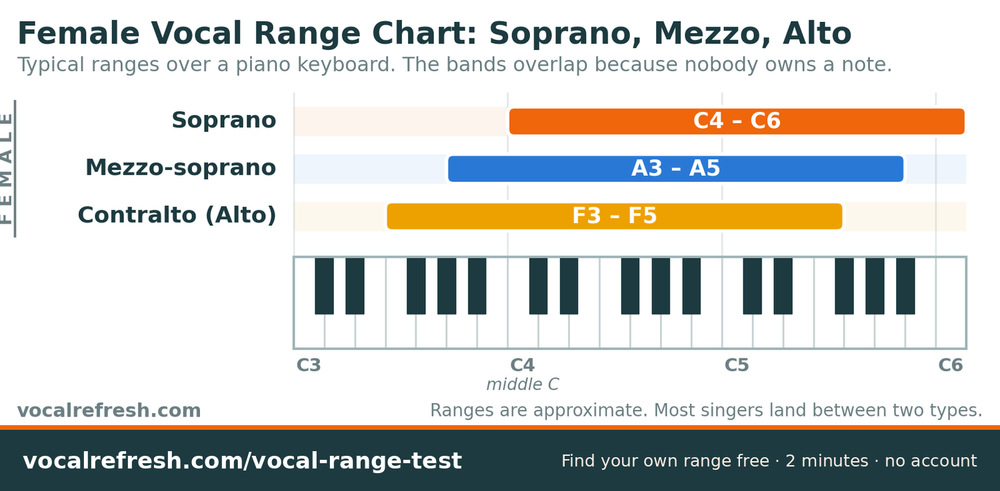
The three bands above: soprano C4–C6 · mezzo-soprano A3–A5 · contralto, usually called alto, F3–F5. Approximate, and they overlap heavily.
The female vocal range runs from roughly F3, the F below middle C, up to about C6, two octaves above it. Charts split that span into three voice types: soprano C4–C6, mezzo-soprano A3–A5, and contralto F3–F5. Mezzo-soprano is the most common. True contralto is rare, and far rarer than the number of women who have been calling themselves altos since high school.
That last part is why this page exists. A chart will happily sort you into a box, and the box is often wrong — not because the chart is badly drawn, but because most women read their own voice through a choir seating chart from twenty years ago. So: the three types, what your two notes actually mean, and how to tell a genuine contralto from a mezzo who reads harmony well.
Quick answers
- What are the three female voice types?
- Soprano (C4–C6), mezzo-soprano (A3–A5) and contralto, also called alto (F3–F5).
- What is the most common female voice type?
- Mezzo-soprano. It sits in the middle and it is where most adult women land.
- Is E5 a high note for a woman?
- It is a normal ceiling, not a stunt note. E5 is the top of the mezzo band. F5 and above starts to read soprano.
- Is A5 a high note for a female voice?
- Yes. A5 is the top of the soprano-leaning range and five semitones above E5.
- Am I an alto or a soprano?
- If the question comes from a choir part you were given, it probably answers neither. See below.
Not sure where your two notes actually are?
Sing three notes and the test finds them for you — one that feels easy, then your lowest, then your highest. Hum them if you would rather. Nothing is recorded or saved.
Your result and a plan for your voice come by email after the test.
What is the female vocal range?
Your vocal range is the distance between the lowest note you can sing cleanly and the highest, written as two notes with octave numbers. G3 to E5. F3 to C6. The number after the letter tells you which octave the note sits in, and middle C — the white key in the middle of a piano — is C4.
Across women as a group that span covers about F3 to C6, though nobody has a range that wide on their own. Most adults who are not training daily have somewhere between an octave and a half and two octaves to work with, and where that octave and a half sits is what decides the voice type. Two women can both have a 19-semitone range and be a mezzo and a contralto, because one of them starts higher.
Cleanly is the load-bearing word. The note you scraped once, at full volume, in the car, is not in your range until it turns up on an ordinary Tuesday at a normal volume on purpose.
The female vocal range chart
| Voice type | Typical range | Where it sits |
|---|---|---|
| Soprano | C4 to C6 | The highest common female voice; bright and clear on top |
| Mezzo-soprano | A3 to A5 | The female middle, and the most common women's voice |
| Contralto (alto) | F3 to F5 | The lowest common female voice; warm and full underneath |
Read the bands as neighbourhoods, not fences. A mezzo shares her top octave with sopranos and her bottom octave with contraltos. Nobody owns a note, and the borders move depending on which chart you are looking at — you will find versions that stretch soprano to F6 or drop contralto to E3, and none of them is wrong, because the categories came out of classical casting rather than anatomy.
Three types is the solo classification. If you want the full six including the male voices, the six-voice-type chart is on the main vocal range page.
The three female voice types in detail
Soprano — C4 to C6
The highest of the three. A soprano's voice tends to stay bright and free above the staff where other voices start working, and she usually finds the bottom of her range thinner and less interesting than the top. If a dependable F5 or higher is available to you, soprano is the likely read.
A caution worth having: plenty of women can reach soprano notes without being sopranos. Reaching is not the same as living there. What matters is where the voice sounds like itself for a whole song.
Mezzo-soprano — A3 to A5
The middle voice, and the one most women turn out to have. A mezzo has usable weight at the bottom and a working top, which is exactly why she gets handed whichever choir line is short that season. Most pop and musical-theatre writing for women sits in mezzo territory, which is why so many women can sing along to the radio comfortably and then struggle with a hymn written for sopranos.
On our own thresholds, a comfortable ceiling anywhere from G4 up to E5 reads mezzo-soprano.
Contralto (alto) — F3 to F5
The lowest of the three, and genuinely rare. A real contralto has a rich, substantial bottom octave that carries without pushing, and she usually finds the top of the mezzo range effortful rather than merely high. A comfortable ceiling below G4 points here.
Rare is the operative word. If a chart has typed you contralto, before you accept it, read the next section.
Am I an alto or a soprano?
This is the most common question I get, and the honest answer is that it is usually the wrong question, asked in the wrong vocabulary.
"Soprano and alto" is a two-part split from choral writing. SATB — soprano, alto, tenor, bass — describes the four lines a piece is arranged for. It is about which line you sing on a Tuesday night, not about the voice you have. The three-type chart above is the solo classification, and the two systems only overlap by accident.
So if you sang alto in a choir, that tells you what your director needed covered. Directors fill sections. The women who get parked on the alto bench are frequently the ones who read harmony well and do not fall off an inner line, which is a musicianship skill rather than a voice type. A great many self-described altos are mezzos who were useful.
Two things actually separate the two, and neither is your top note:
- Where the voice sounds like itself. Sing a phrase you know well in three different keys. One of them will feel like talking and the others will feel like work. That comfortable band is your tessitura, and it says more about your type than either endpoint.
- What the bottom sounds like. A contralto's low notes have body and carry across a room without pushing. A mezzo can hit the same notes, but they go quiet and lose colour. Record yourself on an A3 and listen to whether there is anything down there.
One more thing, and it is the reason I am careful about typing anyone on a single reading. Time away from singing reads on a chart exactly like a lower voice type. The top of a range is the first thing to go quiet after years of not using it, and the first thing to come back. A woman who has not sung since her thirties will often measure as a contralto in week one and a clear mezzo a couple of months later, without anything about her having changed except use. If you are coming back after a long break, treat a low reading as a snapshot of this week, not a verdict.
What your two notes mean
Most people arrive with a pair of notes from a piano or an app and want the verdict. Here are the spans women look up most often. Semitone counts are exact; the voice-type call uses the same thresholds as our vocal range test — a dependable top note of F5 or above reads soprano, G4 up through E5 reads mezzo-soprano, and below G4 reads contralto.
| Your range | Semitones | Voice type |
|---|---|---|
| G3 to E4 | 9 | Contralto — a narrow reading; worth re-testing after a warm-up |
| F3 to F4 | 12 (1 octave) | Contralto |
| G3 to A4 | 14 | Mezzo-soprano, right at the lower edge |
| A3 to C5 | 15 | Mezzo-soprano, and an ordinary place to start |
| G3 to C5 | 17 | Mezzo-soprano |
| F3 to C5 | 19 | Mezzo-soprano |
| A3 to E5 | 19 | Mezzo-soprano |
| G3 to D5 | 19 | Mezzo-soprano |
| E3 to C5 | 20 | Mezzo-soprano with an unusually deep floor |
| G3 to E5 | 21 (just under 2 octaves) | Mezzo-soprano |
| F3 to D5 | 21 | Mezzo-soprano |
| G3 to F5 | 22 | Soprano, just inside the line |
| F3 to E5 | 23 | Mezzo-soprano |
| C3 to C5 | 24 (2 octaves) | Mezzo-soprano with a very low floor |
| E3 to E5 | 24 (2 octaves) | Mezzo-soprano |
| A3 to A5 | 24 (2 octaves) | Soprano |
| G3 to G5 | 24 (2 octaves) | Soprano |
| F3 to A5 | 28 | Soprano, with a working low register |
| F3 to C6 | 31 (about 2½ octaves) | Soprano, and a wide range by any standard |
| E3 to C6 | 32 | Soprano, and unusually wide |
If your pair is not on the list, count the semitones yourself — every key on a piano, black ones included, is one semitone — and read the type off your top note.
Is E5 a high note for a woman?
No, and this is worth saying plainly because a lot of women are quietly disappointed by a number that is completely normal.
E5 is the top of the mezzo-soprano band. It is a full third above A4, it is above most of what pop writing asks for, and it is a perfectly good ceiling for an adult voice. F5 is where the reading tips over into soprano. A5 is a genuinely high note, five semitones above E5 and well inside soprano territory. C6 is the top of the chart.
Downward: G3 is not a low note for a woman. It sits inside both the contralto and the mezzo bands, and it is where most women coming back to singing find their floor. F3 is the bottom of the standard chart, and E3 is below it, which is unusual and worth knowing about.
Does a woman's vocal range change with age?
Yes, and the change most women notice first is at the top — the comfortable ceiling sitting lower than it did at thirty, or the top notes thinning out before anything else does. Some women report changes through perimenopause and menopause; that is a real thing singers talk about, and I would rather point you at it honestly than pretend a chart covers it.
I am a voice coach, not a clinician. If you have persistent hoarseness, pain when you sing, or a sudden change in your voice, that belongs with a laryngologist and not with a range chart. Nothing on this page is a substitute for that.
What I can tell you is that a lower reading is not automatically an age reading. Disuse and age look identical on a chart and behave completely differently in practice: one of them comes back. If you want the longer version, I have written about how the female voice actually changes after 45 and about singing through menopause separately.
How to find your voice type at home
You need a piano, a keyboard app or a tuner, plus about five minutes. Warm up first, because a cold voice under-reports at both ends — a five-minute warm-up is enough.
- Find your floor. Start on a comfortable note in the middle of your voice and sing down a scale on an "ah", one note at a time. Stop at the last note that still comes out cleanly. Write down its letter and octave number.
- Find your ceiling. Come back to that middle note and go up the same way. Stop at the last note you can sing without straining or squeezing. Shouting one higher does not extend a range; it just makes a throat sore.
- Find the comfortable one. This is the step most people skip and it matters more than the other two. Sing a phrase you know in a few different keys and notice where it stops feeling like effort. That is the note your voice type should really be read from.
- Check it against the chart. F5 or higher reads soprano, G4 to E5 reads mezzo, below G4 reads contralto. Straddling two is normal and does not change a single thing you should practise tomorrow.
Measure twice on different days if the number surprises you. Voices vary with sleep, hydration and the hour — mornings almost always read low. And if you would rather not do the arithmetic, the test does all four steps and emails you the result.
Sing three notes. See where your voice sits today.
One note that feels easy, then your lowest, then your highest. Hum or sing them. Nothing is recorded or saved, and you get your voice type, your span in octaves and the songs that fit it.
Your result and a plan for your voice come by email after the test.
Female voice types, answered
What are the three female voice types?
Soprano, mezzo-soprano and contralto. On a standard chart soprano covers C4 to C6, mezzo-soprano covers A3 to A5, and contralto — usually called alto — covers F3 to F5. The bands overlap, and most women land between two of them rather than squarely inside one.
What is the most common female voice type?
Mezzo-soprano. It occupies the middle of the female range, it is where most pop and musical-theatre writing for women sits, and it is the type most adult women read as when they measure their comfortable ceiling rather than their highest reachable note.
What is the rarest female voice type?
True contralto. A real contralto has a rich, carrying bottom octave and finds the upper mezzo range effortful rather than simply high. Far more women are labelled alto than are actually contraltos, because "alto" in a choir describes the line you were given, not the voice you have.
Is E5 a high note for a woman?
E5 is the top of the mezzo-soprano band and a normal ceiling for an adult female voice, not a stunt note. F5 and above begins to read soprano. A5 is five semitones higher than E5 and is genuinely high.
Is A5 a high note for a female voice?
Yes. A5 sits at the top of the soprano band on a standard chart, five semitones above E5. Reaching it occasionally is not the same as owning it — a note counts as part of your range when it is available at a normal volume on an ordinary day.
Am I an alto or a soprano?
If the question comes from a choir part, it answers neither. Soprano and alto are the two upper lines in SATB choral writing and describe what you sing in a piece. The solo classification has three female types, and most women given alto lines are mezzo-sopranos. Judge by where your voice feels comfortable across a whole phrase, and by whether your bottom octave has real body, rather than by the part you were assigned.
What does a range of G3 to E5 mean for a woman?
21 semitones, a little under two octaves, reading mezzo-soprano. It is one of the most common results women get, and a solid working range for most of what you would want to sing.
Does a woman's vocal range change with age?
It does, and the top of the range usually shows it first. Some women report changes through perimenopause and menopause. Ingrid Moss is a voice coach and not a clinician — persistent hoarseness, pain, or a sudden change in the voice should be seen by a laryngologist. Worth knowing too: years away from singing produce a low reading that looks identical to an age-related one on a chart, and that one comes back with use.