Best Singing Practice Apps (2026): 7 Tested for Women Returning to Singing
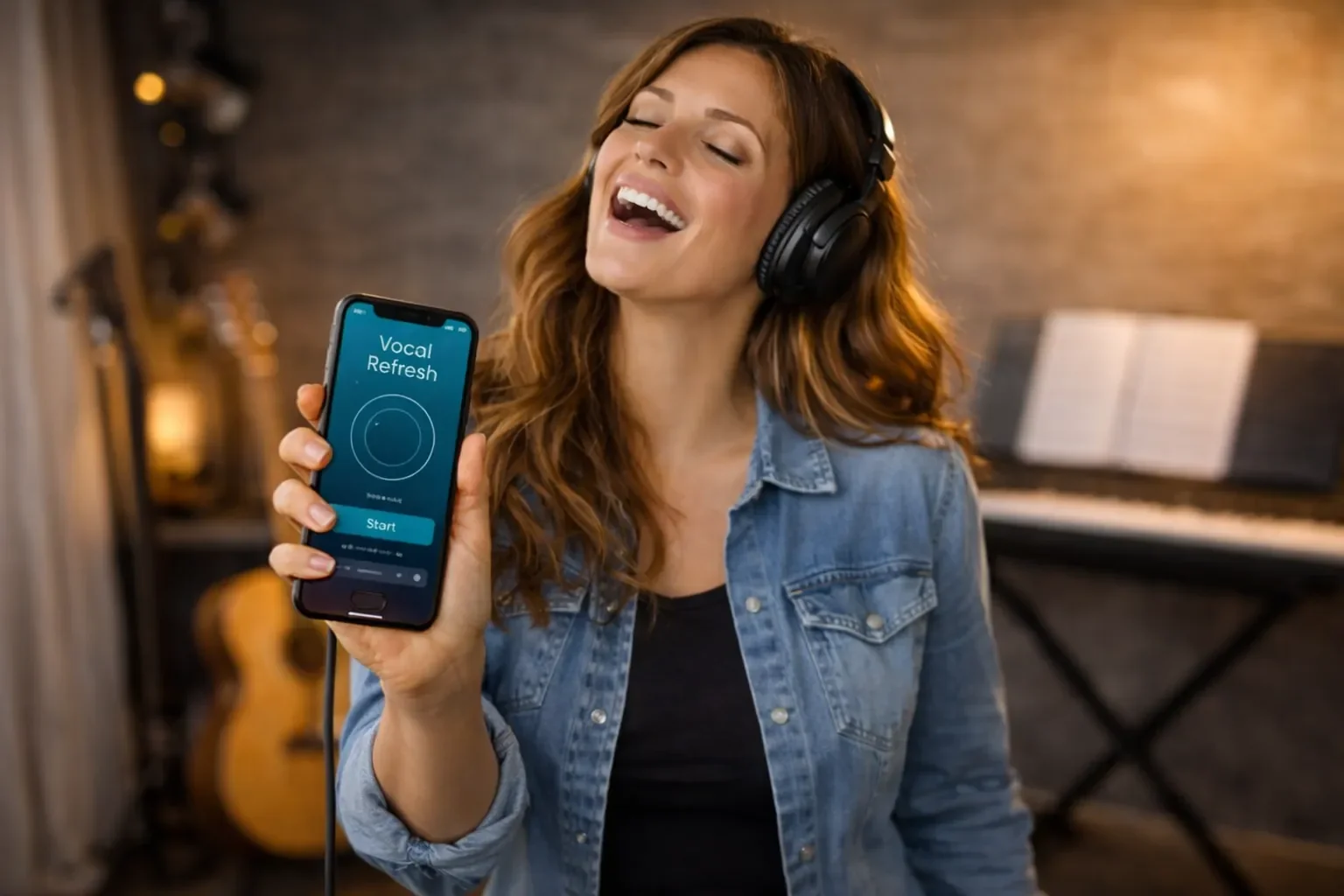
There are plenty of singing app roundups written by nobody in particular. This one asks a narrower question: which app actually fits a woman's voice — specifically the voice of a woman coming back to singing after years away? Not which one has the softest branding. Which one handles what female voices genuinely deal with: the register shift that sits around E4 to G4 for many women, the changes that arrive with pregnancy and perimenopause, and content that was not written for a 22-year-old tenor.
I have taught voice for more than 25 years. Most of my students are women between 38 and 60 who sang in choirs, musicals or bands, stopped for kids or work or both, and want to ease back in without an audience. I have watched a lot of them download an app on Monday and delete it by Friday. The app usually is not bad. It is aimed at someone else.
Every app in this table treats a returning singer as a beginner.
That is the gap Vocal Refresh was built for. A short voice check finds where your range sits today, then you get a five-to-twenty-minute session for that voice — private, no audience, no scores. Founding members pay $69.99 a year, held for three years. iOS at launch, with a free tier and a 14-day trial.
No spam. Leave any time.
The 2026 apps at a glance
Ranked by how well each one fits a woman rebuilding her voice, not by popularity. App names link to a fuller comparison of each.
| App | Best for | Price | Free option | Biggest limitation |
|---|---|---|---|---|
| Simply Sing | Singing real songs in your own key | $14.99–$19.99/mo or $59.99–$89.99/yr, varies by offer (AI Overview, not publisher-confirmed) · iOS, Android | Free to start | Scores pitch and timing only, so it cannot hear strain |
| Sing Sharp | Seeing your pitch and finding your bridge | Free with ads, or $19.99/mo ($99.99/yr membership) (AI Overview, not publisher-confirmed) · iOS, Android | Free to download; range and tone-deaf tests free | Most of it needs the paid membership |
| Yousician | A full curriculum, or several instruments | Price not published · iOS, Android, Mac, PC | Free to download | Voice is one track on a general platform, with streaks and scores |
| 30 Day Singer | Learning from structured video lessons | $10.75/mo billed annually ($129/yr) · browser only | Free Basic tier at $0 | Nothing listens back; feedback costs $100–$150 an hour |
| Singing Carrots | Free tools and finding songs in your range | From $119.99/yr, vendor-stated · browser + free iOS app | Range test free, no account | A set of separate tools rather than a guided program |
| Vocal Refresh — ours | Rebuilding a voice after years away | Founding-member pricing via the waitlist · iOS in development | Browser range test, live today | Unreleased, so the waitlist is the only way in for now |
Prices and platforms from competitors.json, verified 2026-08-26 and 2026-08-27, except Simply Sing and Sing Sharp, whose prices come from a Google AI Overview citing Apple (2026-09-20), not the companies' own sites or the App Store, which still publish no price directly. Where a company does not publish a price at all, this table says so rather than estimating one. We make Vocal Refresh, which is why it is listed last and marked.
Full hands-on write-ups for every app here sit in our singing app reviews. For the two browser range checkers, see the PitchTest review and the VocalCheck review.
Is there a free vocal practice app?
Singing Carrots has the best free diagnostics on this list. The range test needs no account at all; the pitch tools ask for a free login but cost nothing. If you want free tools and nothing else, start here.
30 Day Singer goes further than a trial. Its Basic plan sits at $0/month permanently, with sample lessons and a weekly newsletter. That is a standing free tier, not a countdown.
Yousician, Sing Sharp and Simply Sing are all free to download, but the real lessons live behind a subscription in each one. Sing Sharp's vocal range test and tone-deaf test are the exceptions. Those stay free.
Vocal Refresh is free to start too. The Vocal Snapshot costs nothing, and a free tier is planned for launch alongside the trial. This is my own app, so weigh that accordingly.
Free tier at launch, plus a 14-day trial of the paid plan.
iOS at launch, with a free tier and a 14-day trial of the paid plan. Vocal Refresh opens to founding members first, at $69.99 a year held for three years. That price is our thanks for backing it before it shipped.
No spam. Leave any time.
Not ready for a waitlist? Take the free vocal range test.
Disclosure, before anything else
I built one of the apps on this list. Vocal Refresh is mine, it is marked clearly wherever it appears, and it is listed last in the comparison table for that reason. Where a different app would suit you better, I say so — and for several types of singer, a different app genuinely is the better answer. Read the "who should skip it" line under my own app before you read anything else.
A note on method. These are not apps I skimmed in an app store one afternoon. They are the ones my students mention, ask about, or arrive already using, which means I get to see the part no review captures: whether a real adult with a real schedule is still opening the app in week six. That second question turns out to matter far more than any feature list.
What a woman's voice needs that generic apps skip
Register balance first. For many women the trickiest patch of the voice is the middle, roughly E4 to G4, where chest voice and head voice have to negotiate. Generic app exercises tend to either park you below that zone, so you never learn to cross it, or leap straight over it, so you strain. An app can only help here if it knows where your voice actually sits, which means it has to measure you before it drills you. If that middle patch is your sticking point, head voice vs chest voice explains what is happening there.
Hormones second. Pregnancy, postpartum recovery, perimenopause and menopause all change the instrument. Many women in their late forties notice the bottom of the range dropping slightly and the top needing more warm-up time than it used to. That is physiology, not decline: the vocal folds thin with age, which lowers the speaking pitch, and one clinical summary reports that hormone replacement prevents around 14 Hz — about 1.3 semitones — of that drop.1 I go through the whole picture in how a woman's voice changes with age. But it means exercises pitched for a young soprano can be actively discouraging, and an app that never re-measures you will keep training a voice you no longer have.
Content third. Song libraries and demo exercises skew high, bright and young. If you are an alto and an app keeps handing you songs in soprano keys, it is quietly telling you your voice is wrong. Your voice is fine. The app is wrong. Knowing where your range actually sits is what lets you filter that noise out.
Then add the practical layer, which knocks out more apps than any technical criterion does. Sessions need to be short: five to ten minutes is the realistic window for most adults I teach, and a 40-minute daily lesson plan sounds noble in January and gets abandoned by February. Privacy matters more than app designers think: many returning singers are not ready to hear recordings of themselves in week one, and the gap between how you remember sounding and how you sound right now can be genuinely painful. And the tone should encourage rather than grade. A voice that has not sung in fifteen years does not need a red 43 percent flashing at it. It needs a nudge and a next step.
The best app is not the one with the most features. It is the one you are still opening in week six.
The 2026 ranking for women's voices
1. Vocal Refresh — ours
Full disclosure again: this is my app, and I built it for exactly this reader, because nothing on the market served her.
Everything starts with a free assessment called the Vocal Snapshot. You sing a few guided notes into your phone and it measures four things: your vocal range as it is today, not the range you remember having; how long you can sustain a steady note, which is a decent proxy for breath support and stamina; your pitch accuracy; and your comfortable midpoint, the part of your range where your voice sits most easily right now.
That midpoint is the number I care about most for women, because it tells the app where your voice actually lives, alto or otherwise, and every daily exercise is built from it. After the snapshot, the app gives you a five-minute routine each day. You tell it how your voice feels at that moment — rusty, slightly warmed up, or ready — and it adjusts. Recording is optional and stays private, and nothing scores you.
Who should skip it: advanced singers preparing a specific audition, and anyone who mainly wants help choosing repertoire and shaping performances. That work needs a human, and no app should claim otherwise. If you want measurement tools today and are happy without a guided path, Singing Carrots below is free and better for that.
2. Singing Carrots
The free range test and pitch tools are the best no-cost diagnostics around, and the song search by range is one of the most alto-friendly features in any app: filter the database by your measured range and it stops offering you soprano keys. Sessions run 10 to 20 minutes and most exercises expect you to sing into the microphone or record.
Nothing in it is designed around female register balance or hormonal change, but the measurement tools respect whatever voice shows up, which is more than most apps manage. My students who love data love this app. What it lacks is warmth: it feels like a utility rather than a coach, with no pathway that says do this today, then this tomorrow. There is also a free iOS app, Singing Carrots AI Vocal Coach, which puts the same tools on your phone. There is no Android app, so Android users work in the browser. A very good free companion.
3. 30 Day Singer
A library of video lessons covering technique, warm-ups and styles, with good production quality. It leans toward structured courses, which suits people who like a curriculum.
The catch is that a course can feel like homework. Several of my students finished week one enthusiastically, missed two days in week two, and never went back, because falling behind the plan felt like failing it. Nothing in the curriculum is built around a female instrument mid-change either. If you are the person who finishes every workbook you buy, this could be your app. Be honest with yourself about whether you are.
4. Sing Sharp
Pitch training and ear development, with a live waveform so you can watch your pitch as you sing. That visual feedback helps with the pitch wobble so many returning singers worry about. Sessions run 10 to 15 minutes and it expects recording. It has no concept of registers and no idea where a woman's voice transitions, so treat it as an ear gym rather than a voice program.
5. SongTorch
For learning specific songs. It slows tracks down, isolates parts, and gives you stripped-back backing tracks to practice against. Once you have rebuilt basic coordination and chosen a song in a key that suits your voice, it is a lovely practice partner. It teaches you the song, not the voice, which makes it a good second app rather than a first one.
6. Yousician
Polished, gamified, and effective for people who love streaks — the most arcade-like app here, with lessons, real-time pitch feedback and streak counters. For some people that game layer is exactly the motivation they need.
Judged through a women's-voice lens it drops down the list: the exercises are pitched generically, and the constant scoring lands hard on a voice that is mid-change or mid-comeback. One student described practicing with it as karaoke night with a grumpy referee, and I have seen a graded wobble send a student to bed discouraged instead of back to practice. If your confidence is solid and you like earning points, it works. If confidence is the thing you are rebuilding, be careful.
7. Smule
Karaoke with a community. Sessions are short, often three to five minutes, but everything gets recorded because performance is the whole point. Some women love the community and thrive on it, and plenty of people have rediscovered the sheer pleasure of singing through it. Many of my students find publishing their voice to strangers the exact opposite of what a comeback needs. Fun, worth knowing about, not training.
Also on the market: Singeo, Singorama and Swiftscales
Singeo and Singorama are course-based programs, and Swiftscales is essentially a warm-up and scale generator you drive yourself. Each has its fans. All are built around either general beginners or working singers who already practice daily. None will hurt you. None will feel like it was written for a 48-year-old alto coming back after a long gap, because it was not.
Seven apps tested, and the same gap runs through all of them.
None of them start from the voice you have now. Vocal Refresh does: the voice check places you, and the daily session is built around that reading rather than lesson one. Free to join, and founding members pay $69.99 a year, held for three years.
No spam. Leave any time.
Why an app rather than lessons, at least at first
A weekly in-person lesson is really a two-hour commitment once you count travel, and it collapses the moment a child gets sick or a meeting runs long. App practice happens at 6:50 in the morning before the house wakes up, in a parked car before the school run, or while the pasta water boils. One of my students does her entire routine in the pantry with the door closed, because it is the only room where nobody follows her. If that is your situation, practicing singing at home quietly covers the windows in more detail.
The money matters too. In-person lessons typically run $50 to $100 or more per hour in the US. Most apps cost between $10 and $40 a month, and free tiers exist. An app is a cheap experiment you can quit without guilt, while a term of lessons is a commitment many women defer for years waiting for the right moment.
And privacy rebuilds confidence faster than an audience does. Early comeback practice is wobbly. That is not a flaw, it is the process, but it feels bad when someone is listening. I consistently see private practicers sing for other people sooner than students who forced themselves to perform early. Counterintuitive, but I have watched it for years.
Voices respond to frequency more than duration: five focused minutes a day grows range, breath control and pitch steadiness in a way that one long Sunday session never matches. I compared the two options honestly, including full costs, in my guide to singing lessons versus apps for adult beginners.
What an app will not do
An app cannot watch your posture, catch jaw tension, or tell you why one specific note keeps misfiring. It cannot choose repertoire that flatters your exact voice, and it cannot sit with you through the emotional part of coming back to something you loved. If any of those become the blocker, that is your cue to book a human.
How to choose
- DataYou love numbers and want strong free tools — Singing Carrots.
- CoursesYou want video lessons and you reliably finish courses — 30 Day Singer.
- GamesYou are motivated by streaks and points — Yousician.
- FunYou mostly want to sing with other people — Smule.
- SongsYou want to polish specific pieces — SongTorch.
- DIYYou prefer to build your own drills — Swiftscales or one of the course programs.
- ComebackYou used to sing, stopped for years, and want a short private daily routine built from your actual range — Vocal Refresh, which is mine.
And use the trials. Nearly everything on this list lets you poke around free for at least a few days. Give a candidate one honest week: a short session most days, at the time of day you would realistically practice. If you catch yourself inventing reasons not to open it by Thursday, that is your answer, and no amount of five-star reviews will change it.
How to practice singing at home, with or without an app
An app can keep you company and keep score. The plan below is yours either way: ten minutes, the same shape every day, and it works with any app in the table above or with none of them.
Minutes 1 to 3: warm up on hums and lip trills
Keep it low and quiet. If the house is asleep, hum with your mouth closed; it carries less than talking does. Seven humming warm-ups gives you a full quiet set, and the warm-up routine builder will time one out for whatever minutes you actually have.
Minutes 4 to 7: one exercise in the part of your range that is weakest right now
Not the part you like best. If you are not sure which part that is, the free range test takes about two minutes and tells you, in note names, along with the register shift most women your age are managing.
Minutes 8 to 10: one song, in a key that actually fits
Sing it once, record thirty seconds on your phone, and stop there. Listening back the next day, not the singing itself, is where the practice happens.
What to remember
Most singing apps are competently built and aimed at somebody who is not you. The ones worth your time measure your voice before they drill it, keep the sessions short enough to survive a real week, and do not grade a voice that is still finding itself.
Start free, give it one honest week, and judge it on Thursday.
Sources. 1. Osborne Head & Neck Institute. How hormones affect the voice. 2. University of Minnesota Lions Voice Clinic. Physiology of voice production.
Not sure which to try? Start with your own two notes.
The free vocal range test runs in your browser in about two minutes, and nothing is recorded. Join the waitlist and we will send your result, the singer whose range matches yours, and a warm-up built for those two notes.
No spam. Leave any time.
Frequently asked questions
What is the best singing app for women over 40?
Look for three things: a real range assessment rather than fixed starting pitches, short sessions, and optional recording. Singing Carrots covers the free measurement side well. I built Vocal Refresh specifically for women returning to singing in their 40s and beyond, with five-minute routines built from your measured range, so that is my honest but biased recommendation.
What is the best free app to learn singing?
Two, depending on what you want. Singing Carrots is the best free diagnostic set — free range test, free pitch tools, a song database filtered by your own range, no trial, no card, no time limit. Vocal Refresh is the best free starting point if you are coming back to singing after years away: the vocal range test is free, takes two minutes and needs no account, and the Vocal Snapshot costs nothing. 30 Day Singer has the most complete free lesson plan — a permanent $0 Basic tier with sample lessons and a newsletter, not just a trial. Pick one, use it free for a week, pay only once you know what you're missing. (Vocal Refresh is my own app, so weigh that accordingly.)
Do women need different vocal exercises than men?
The mechanics of healthy singing are the same, but the practical details differ. Many women's trickiest register transition sits around E4 to G4, and exercises need to work through that zone rather than avoid it. Starting pitches, key choices and repertoire also need to fit the voice in front of them, which generic exercise sets usually do not.
Does menopause change how I should train my voice?
Often, yes. Menopause brings a relative androgen effect, and the vocal folds thin with age, which in women lowers the pitch of the speaking voice. One clinical summary notes that hormone replacement appears to prevent about 14 Hz of that drop, roughly 1.3 semitones. Practically, many women notice a lower comfortable range and a longer warm-up time. Choose an app that lets you re-measure your range and adjust, because the voice you train at 52 is not the one you had at 35.
Which singing apps work best for altos and low female voices?
Any app that measures your range first and then filters content by it. Singing Carrots lets you search its song database by your measured range, which helps you find alto-friendly keys, and Vocal Refresh builds its daily warm-ups from your measured comfortable midpoint. Avoid apps that pitch every demo and exercise for high voices with no adjustment.
Can a singing app actually improve my voice?
For pitch accuracy, breath stamina, range and consistency, yes. Regular short practice is the main driver of vocal progress, and apps are very good at making practice regular. With five to ten minutes a day, most returning singers notice easier onsets and steadier pitch within two to three weeks, and measurable range or stamina gains within about eight weeks. What an app cannot do is diagnose why a specific note feels tight, or watch your posture and jaw, which is where a human coach earns the fee.
Should I start with a singing app or with singing lessons?
For most returning adults I recommend starting with an app to rebuild the daily habit, then adding occasional lessons when you hit a specific problem like strain or a stubborn plateau. In-person lessons typically cost $50 to $100 or more per hour in the US, so it makes sense to spend that money once you know what you want fixed.
Is Vocal Refresh free, and what does the Vocal Snapshot measure?
Vocal Refresh is free to start, and the Vocal Snapshot is included at no cost. It measures your current range, note sustain, pitch accuracy and comfortable midpoint. The app is iOS at launch and in waitlist mode while founding members are onboarded. There is no Android version and none has been announced. The range test itself runs in any browser. This is my own app, so weigh that accordingly.