Can Anyone Learn to Sing? Yes, at Any Age
Almost every adult who books a first lesson with me asks some version of this question in the opening five minutes, usually with a nervous laugh, already braced for me to let them down gently. So let me be the vocal coach who doesn't.
Yes. Almost anyone can learn to sing. In more than 25 years of teaching I have met exactly a handful of people whose ears genuinely could not do the job, and I have met hundreds who had been told they couldn't sing by someone who had no business making that call. The voice that reads bedtime stories, hums in the car and calls everyone in for dinner is the same instrument a trained singer uses. It is not expired. It is out of practice, and out of practice is a fixable condition.
Women often ask this at menopause, when the voice has changed enough to feel like a closed door. It is not.
The short version
Can anyone learn to sing? Almost certainly, yes. Singing is a physical coordination skill built from breath, muscle control and pitch matching, and all three are trainable. Genuine tone deafness affects roughly 1.5% of people. Age is not a barrier either: what changes with the years is your starting point, not your ceiling. Most adult beginners hear a real difference inside two to four weeks of short, daily practice.
Can anyone learn to sing?
Start with the mechanics, because they take the mystery out of it. Singing happens when air from your lungs passes through your larynx and sets your vocal folds vibrating; the throat, mouth and nose then shape that buzz into a tone. The faster the folds vibrate, the higher the pitch — and the speed is governed by muscles you can train, in exactly the way you can train the muscles that let you swim or touch-type.
So the honest requirements are short. You need a working speaking voice. You need to be able to hear whether a note goes up or down. And you need to be willing to repeat something small often enough that your body learns it. That is the whole list. Nowhere on it is "born with it."
What people usually mean when they say they can't sing is that the sound coming out doesn't match the sound in their head. That gap is real, and it is also the single most trainable thing about singing. It is a connection problem between your ear and your voice, not a defect in either one.
Is singing a natural talent, or a learned skill?
Both, in roughly the proportions you'd expect from any other skill. Some people start with a better ear, a longer natural range, or a household where singing happened every day. That is a head start, not a gate.
The talent myth does real damage because it converts a temporary lack of skill into a permanent identity. A seven-year-old told to mouth the words in the school concert becomes a fifty-year-old who says "I can't sing" as though reporting a blood type. In the studio I can usually trace an adult's certainty back to one remark from one person, decades ago, who was not qualified to make it.
Here is the useful way to think about it. Nobody expects to sit at a piano untrained and play well, and nobody concludes from a bad first attempt that they were not born to play piano. Singing gets judged differently only because the instrument is inside you, so a rough sound feels like a verdict on you rather than on your technique. It isn't. It's a report on your current coordination, and coordination moves.
Convinced? Here is exactly how to learn to sing as an adult, step by step.
Can anyone learn to sing at any age?
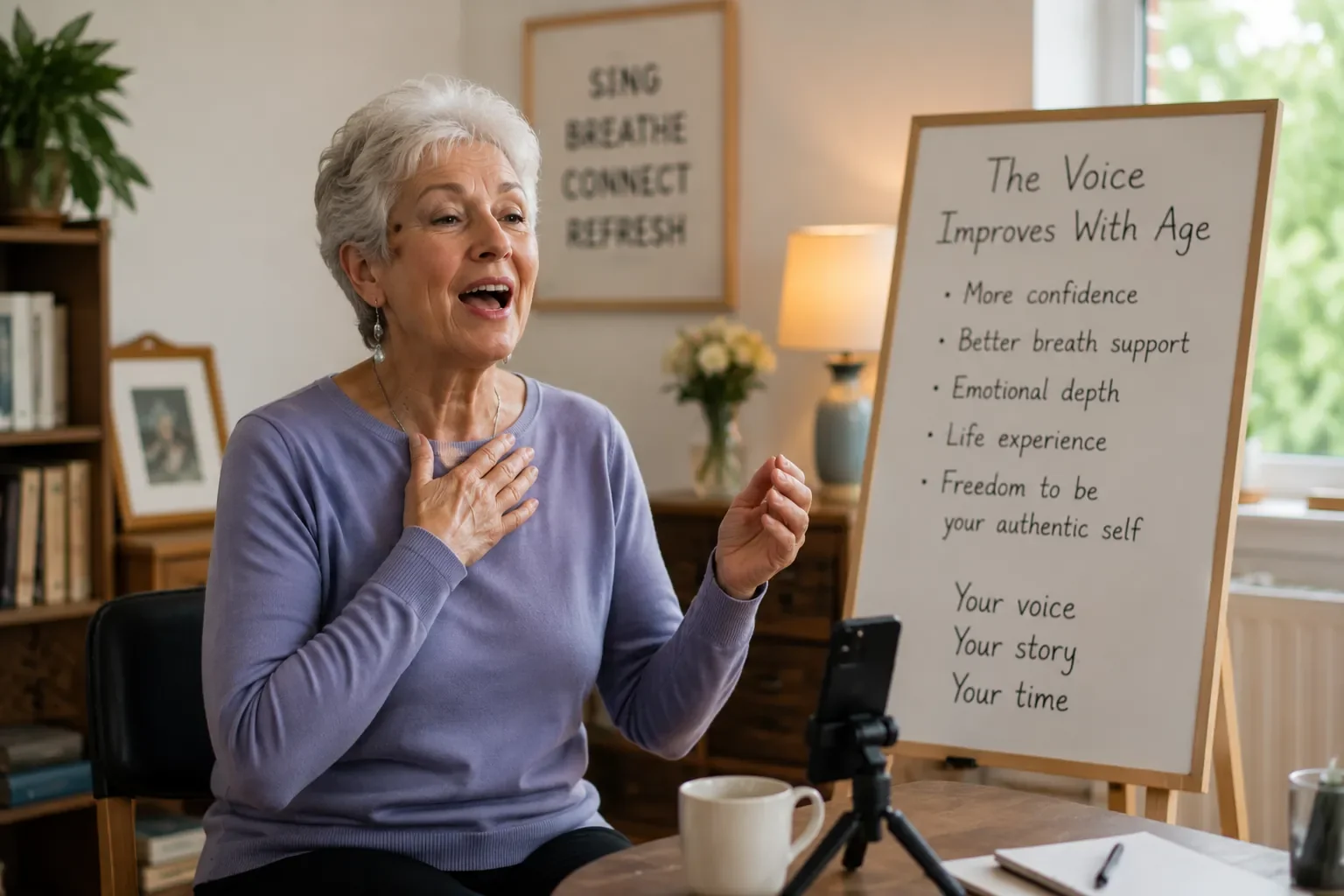
Yes, and this is the part I most want people in their 40s, 50s and 60s to hear. Singing is built on breath, muscle coordination and ear training, and none of those stops being learnable because you've had a birthday, or three children, or a twenty-year gap.
Hormones are part of the picture too, and worth understanding rather than fearing: here is what menopause voice changes actually do to singing, and the routine that helps.
Your voice does change over the decades. The vocal folds lose a little suppleness, breath support softens if it isn't used, and the very top of your range may sit lower than it did at twenty-five. But changed is not the same as diminished, and the change responds to work: the NIDCD notes that vocal training exercises help the muscles of the larynx stay strong against age-related weakening. If you want the physiology in detail, I've written it up in the aging female voice.
What I actually see is that adults who start in their fifties usually sound better at fifty-five than they did at twenty-five. A little less on top, considerably more everywhere else: steadier pitch, better phrasing, and something to say. If you sang years ago and stopped, how to sing again covers the specific business of coming back rather than starting cold.
The window doesn't close. It just stops being the thing standing in your way, and gets replaced by whether you practice.
Can a terrible singer become good?
This is the question underneath the question, so let's use numbers rather than reassurance.
Genuine tone deafness — congenital amusia, a neurological difficulty perceiving pitch at all — is rare. The largest study of it, Peretz and Vuvan's 2017 survey of 20,000 people, put the prevalence at about 1.5%, well below the 4% figure that circulated for decades. Meanwhile, research on singing accuracy suggests that something like 10 to 15% of occasional singers sing out of tune by a strict standard.
Put those together and the picture is clear: for every person whose ear genuinely can't do it, there are roughly eight or nine who sound off-key for reasons that are entirely fixable. Untrained voice. No breath support. Singing in a key that doesn't suit them. Never having practiced the one thing that actually builds pitch, which is matching a note out loud and checking whether you landed on it.
And that practice works. A 2025 study in Musicae Scientiae found that adults who were poor at pitch matching measurably improved their single-note accuracy after targeted training — with the interesting wrinkle that the group who practiced across a wide range improved while the narrow-range group didn't. Stretching matters.
There is a simple test you can run tonight. Put on a song and listen for whether other people singing off-key bothers you. If it does, your ear works. What's missing is the wiring between the ear and the voice, and that is the most trainable part of the whole business. How to sing in tune walks through the drills that build it.
Can you teach yourself to sing, or do you need lessons?
You can absolutely start on your own, and most people should. If the cost is what you are weighing, I compared what singing lessons cost against an app. A teacher speeds things up and catches habits you can't hear, but the first few months are mostly about consistency, and consistency is free.
What you can reliably do alone: build breath support, warm up properly, learn to match pitch, find your comfortable range, and get many quiet repetitions in. What is genuinely hard to do alone: hear tension you've stopped noticing, navigate the break between your registers, and know whether a rough patch is a technique problem or a health one. My honest advice is to work solo for two or three months and then buy a single lesson, if you can, purely as a checkup. A no-audition choir is the cheap alternative: it solves the isolation problem for the price of one evening a week, and the benefits of group singing land faster than most people expect.
Recording yourself is the closest thing to a teacher that costs nothing. Your ears while you sing are getting the sound through your own skull, which is why your voice sounds wrong on playback and why you can't accurately judge yourself in real time. Once a week is enough — often enough to hear change, rare enough not to spiral.
Why adult beginners have advantages teenagers don't
Nobody says this to adults, so I will.
- You practice on purpose. A fourteen-year-old repeats a phrase until they're bored. You repeat it until it's right, then check. That difference is worth years.
- Your ear is decades ahead. Listening keeps sharpening even while the voice sits idle. It's why you can hear exactly how rusty you sound — which feels terrible, but means the judge is already trained and only the athlete needs work.
- You know what you want to sound like. Taste is half of interpretation, and yours took thirty years to build.
- You're not performing for anyone. No auditions, no chair placements, no comparison to the girl who always got the solo. You get to be a beginner in private, which is the fastest way to be a beginner.
How do you actually start? Your first four weeks
Ten minutes a day, most days. Not an hour on Sunday. If you stopped when your children arrived, the four-week plan for starting again after kids maps the same idea onto five minutes a day. Coordination is built through frequent moderate repetition, and a single weekly marathon with nothing in between produces almost nothing.
- Week 1Breath only. Hand on your belly, slow low breaths, ribs and stomach moving out while your shoulders stay still. Then hum gently at speaking pitch for a couple of minutes. That's it — you're building the engine before you ask it to pull anything. Breathing exercises for singing has the full set.
- Week 2Add pitch matching. Play one note on a free piano app, hum it, then check whether you landed on it. Ten repetitions. Move the note. This single drill does more for "I can't sing" than anything else on the list.
- Week 3Add a real warm-up before you sing anything: gentle sirens, lip trills, five minutes. Cold folds are stiff folds, and this is the cheapest habit with the biggest payoff. My vocal warm-up guide has the order.
- Week 4Add one song, in a key that suits you rather than the key the original was recorded in. One verse and one chorus, at half your usual volume. Record it once and keep the file.
Two rules that matter more than the schedule. Practice quietly — humming, lip trills and straw phonation are all quiet enough for a shared house, and coordination improves at any volume. And pick songs that move mostly by step and sit in a narrow range; if the chorus lives at the very top of what you can reach, you will strain every time no matter how good your technique gets. Ready-made drills are in vocal exercises for singers.
How long before you sound different?
Honest timelines, from a studio rather than a sales page.
- Two to four weeks: pitch matching becomes noticeably more reliable, and the throat stops feeling tired afterwards. This is the stage most people quit just before.
- Two to three months: breath support holds through a full phrase, your comfortable range widens at both ends, and you stop bracing before high notes.
- Six months to a year: you sound like a singer rather than a person singing. Tone settles, vibrato may appear on its own, and you can learn a new song without a fight.
The variable that predicts all of this is not talent and it is not age. It is whether you did ten minutes most days. Adults who practice four times a week outrun naturally gifted people who practice once every couple of weeks, every single time.
When it isn't a practice problem
Almost everything on this page assumes an ordinary healthy voice, so it's worth naming the exceptions. Book an appointment with a doctor or an ENT if you have hoarseness that lasts more than two or three weeks, pain when you speak or sing, a voice that keeps cutting out entirely, or a sudden loss of range that arrived overnight rather than gradually.
None of those mean you can't learn to sing. They mean something specific is in the way, and it is worth identifying rather than practicing through.
The honest two-minute answer
Can anyone learn to sing? If you can speak and you can hear that one note is higher than another, then yes — you can learn to sing, and your age has very little to do with how far you get. About 1.5% of people have an ear that genuinely can't do it. Everyone else has an untrained voice, which is a completely different problem with a completely ordinary solution.
Ten minutes. Most days. Breath first, then one note at a time, then a song you love in a key that suits you. That is the entire method, and it has worked for every adult beginner I have ever taught who stuck with it for a month.
Frequently asked questions
Can you learn to sing, or is it natural?
It is learned, with a small head start for some people. Singing is a physical coordination skill built from breath control, muscle control and pitch matching, and all three respond to practice at any age. Natural advantages exist — a sharper ear, a wider starting range, a musical household — but they change how fast you progress, not whether you can. Nobody expects to play piano well untrained, and singing works the same way.
Can a terrible singer become good?
Usually, yes. Genuine tone deafness affects only about 1.5% of people, while roughly 10 to 15% of occasional singers sing out of tune by a strict standard. That means most people who sound bad are untrained rather than incapable, and research has shown that adults who practice pitch matching measurably improve their accuracy. The drill that changes it fastest is playing one note, humming it, and checking whether you landed on it.
Is it possible to teach yourself to sing?
Yes, and most adults should start that way. Breath support, warm-ups, pitch matching and finding your comfortable range are all learnable alone with a free piano app and your phone's voice recorder. What is hard to do solo is hearing tension you have stopped noticing and navigating your register break. A good compromise is two or three months of self-teaching followed by a single lesson as a checkup.
Can anyone learn to sing at any age?
Yes. Breath, muscle coordination and ear training stay learnable throughout adult life. Your voice changes with the decades — the folds lose some suppleness and the very top of your range may drop — but vocal training exercises help keep the muscles of the larynx strong, and what changes is your starting point rather than your ceiling. Most adults who start in their fifties sound better than they did in their twenties.
Is it too late to learn to sing at 50 or 60?
No. Fifty and sixty are ordinary ages to start, and adult beginners often progress faster than teenagers because they practice deliberately and already have a trained ear. Expect a slightly longer warm-up and a top note or two lower than at twenty-five. Expect steadier pitch, better phrasing and more expression in exchange. Ten minutes a day for a month is enough to know what your voice will do.
Can you learn to sing if you have a bad voice?
What people call a bad voice is almost always an untrained voice: no breath support, songs chosen in the wrong key, and no practice at matching pitch out loud. Tone quality changes dramatically once air rather than throat tension is driving the sound. Run one test first — if you can hear when someone else sings off-key, your ear works, and the ear is the part that cannot be taught. Try a one-minute ear test to confirm it.
Can anyone learn to sing high notes?
Most people can extend their range upward, but everyone has a ceiling set by their anatomy, and yours may be lower than a favorite recording. The bigger issue is that high notes are usually lost to technique rather than limits: singers push from the throat instead of letting the tone thin and the breath do the work. Learn where your range actually sits, then train the top gently rather than forcing it.
How long does it take to learn to sing?
With ten minutes most days, pitch matching becomes reliable in two to four weeks, breath support holds through full phrases in two to three months, and you sound like a singer rather than a person singing somewhere between six months and a year. Consistency predicts this far better than talent or age. Four short sessions a week beat one long session every couple of weeks, every time.
Can I learn to sing without anyone hearing me?
Yes, and many adult beginners start exactly that way. Humming, lip trills and straw phonation are quiet enough for a shared house, and headphones plus a phone recorder let you check your pitch privately. Practicing softly does not slow you down, because coordination improves at any volume. Cars, walks and the shower all count as practice rooms.
If you sang before, this is built for you.
Vocal Refresh is a daily practice app for women returning to singing after years away. A short voice check finds your range today, and you get a session built for the voice you have now. Private, no audience, no scores. Join the waitlist and we email you the day it opens. Never sung at all? Our reviews page names the apps built for first steps.
Founding members pay $69.99 a year, held for three years. No spam. Leave any time.