The Benefits of Singing: What Actually Happens in Your Body
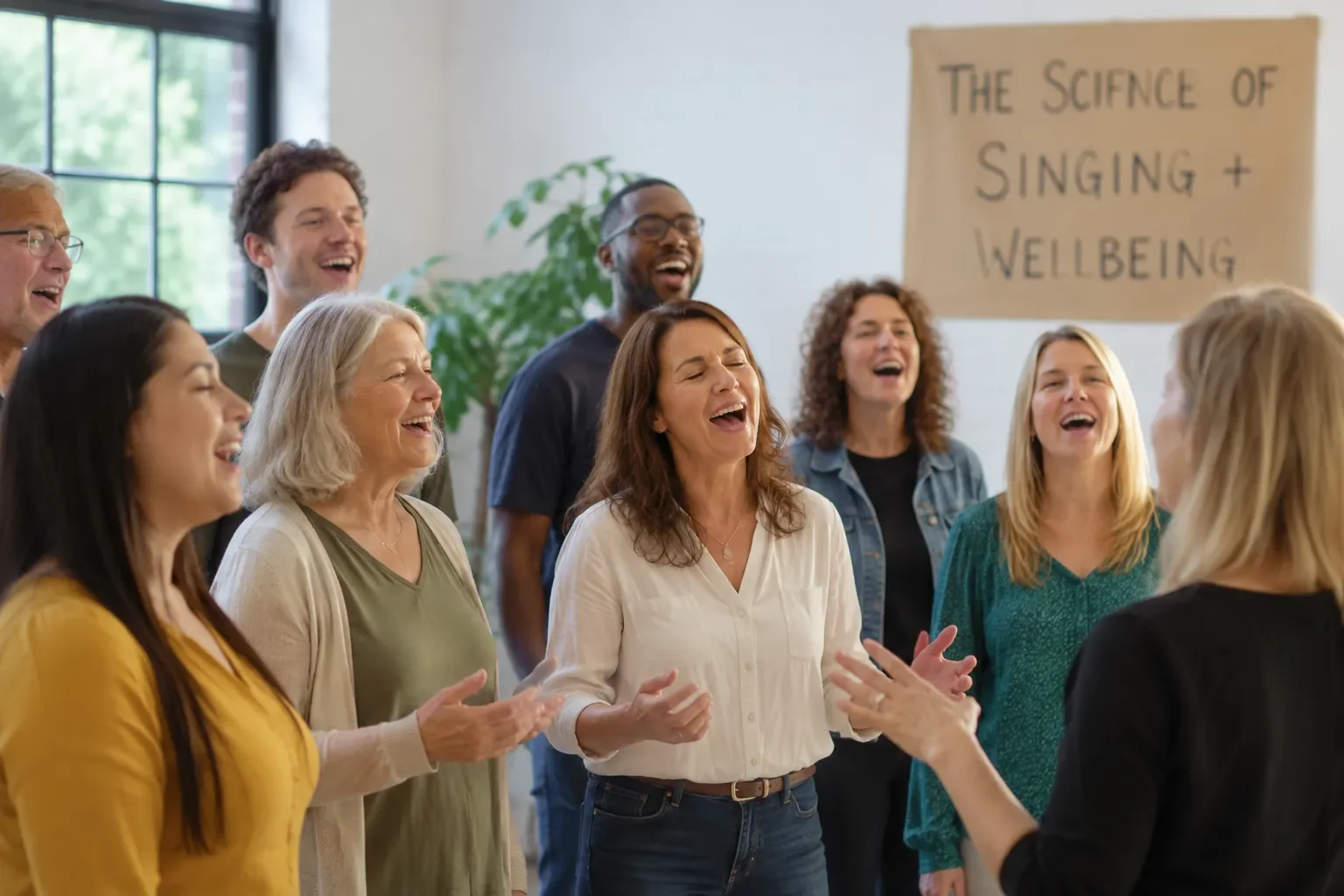
Search the benefits of singing and you get the same listicle a dozen times over: better posture, stronger lungs, sharper memory, a boosted immune system. Some of that holds up. Some of it is one small study stretched a very long way.
I have spent 25 years teaching women who came back to singing in their 40s, 50s and 60s, and I care about this question for an unglamorous reason: people keep singing when it makes them feel better, and they quit when the promises turn out to be oversold. So here is what the research actually supports, what it doesn't, and what that means for ten minutes in your kitchen tonight.
The short version
The strongest evidence is for mood, stress and connection. Singing raises pain tolerance (a proxy for endorphins), and the long slow exhale it forces is the same lever slow-breathing practices pull to calm the nervous system. Group singing shows consistent improvements in wellbeing, and a randomized trial found real reductions in loneliness. The weakest claims are the physical ones — that same trial found no measurable gain in cognition or physical function. Crucially, none of the benefits require you to sing well.
What are the benefits of singing?
Sorted by how much evidence actually sits behind each one, strongest first.
- Mood lift, immediately after. Consistent, measurable, and the effect most people notice themselves.
- Lower stress arousal. Driven by the breathing pattern singing imposes, which is well understood.
- Reduced loneliness and more interest in life, for people who sing with others. Demonstrated in a randomized trial.
- Higher pain tolerance for a while afterward, which is how researchers infer endorphin release.
- Short-term immune markers shifting in a favorable direction. Real, but small studies and brief effects.
- Confidence and self-efficacy. Well reported by participants, harder to measure objectively.
- Memory, cognition, lung capacity, posture. Widely claimed, thinly evidenced. See the honest section further down.
The rest of this page works through each of those, with the studies named so you can check me.
Why does singing feel good?
Because your body pays you for it, in chemicals, within minutes.
Endorphins are hard to measure directly in living people, so researchers use a clever workaround: endorphins raise pain tolerance, so you measure pain threshold before and after. In a study of community choirs, Weinstein, Launay, Pearce, Dunbar and Stewart (2015) found singers could tolerate measurably more pain after a session than before — and, interestingly, the effect was comparable whether they sang in a group of twenty or a "megachoir" of 232. The endorphin lift did not depend on the crowd.
Dopamine plays its part too, the way it does with any absorbing, mildly effortful, rewarding task. And there is a simpler mechanism people overlook: singing is one of the few activities that fully occupies attention. You cannot rehearse an argument in your head and hold a melody at the same time. For a lot of the women I teach, that enforced quiet is half the appeal.
One popular claim deserves a caveat. Oxytocin, the bonding hormone, gets cited constantly in articles about singing — but the evidence is messier than the headlines. A study of group singing in cancer patients and carers found oxytocin decreased after a session, alongside cortisol. Something real is happening; the tidy story about oxytocin is not it.
Does singing reduce stress?
Yes, and the mechanism is the least mysterious thing on this page: it is your out-breath.
Singing forces slow, extended exhalation over long phrases, again and again. That is precisely the pattern slow-breathing practices use deliberately. A systematic review of the field, Zaccaro and colleagues (2018), found that slow breathing "promote[s] a predominance of the parasympathetic autonomic system," mediated by vagal activity and reflected in higher heart rate variability — alongside increased comfort and relaxation and reduced anxiety, anger and confusion.
Singing pulls that lever as a side effect, for as long as the song lasts. This is why fifteen minutes of songs can do what fifteen minutes of sitting meditation does for people who cannot sit through meditation. You are not being disciplined about your breathing. The song is doing it to you.
The hormone data points the same way. Fancourt and colleagues (2016) measured significant reductions in negative affect and increases in positive affect after an hour of group singing, with cortisol falling alongside.
If you want the breathing effect on purpose rather than by accident, the drills in my breathing routine for singers are the same mechanism, isolated.
Does singing boost your immune system?
Modestly, briefly, and with more caveats than the internet admits.
The study everyone cites is Kreutz and colleagues (2004), who took saliva samples from amateur choir members before and after both singing and simply listening to the same music. Secretory immunoglobulin A — an antibody forming a first line of defense in the mouth and airways — rose after singing. It did not rise after listening. The authors concluded that choir singing "positively influences both emotional affect and immune competence," and the singing-versus-listening contrast is what makes the result interesting: the activity mattered, not the music.
Now the honest part. That is a small study measuring a short-term marker. It is not evidence that you will catch fewer colds. Nobody serious claims singing substitutes for sleep, exercise or vaccination. What the research supports is more modest and still worth having: a regular practice that reliably nudges your stress chemistry in a good direction, most days, compounds.
Is singing good for anxiety and depression?
This is the strongest part of the whole picture, and it still comes with a warning label.
A systematic review by Williams, Dingle and Clift (2018) pooled 13 studies covering 667 adults with a mental health condition. Mental health and wellbeing improved with moderate to large effect sizes, and the qualitative studies converged on the same themes: enjoyment, better emotional state, a sense of belonging, and enhanced self-confidence.
The same authors were candid that the underlying studies carried moderate to high risk of bias — small samples, little randomization, high dropout — and called the findings inconclusive pending better research. I would rather tell you that than quote the effect sizes and stop.
The best-designed evidence comes from the Community of Voices trial. Johnson and colleagues (2020) randomized diverse older adults into weekly community choirs and found significantly reduced loneliness (effect size 0.34) and increased interest in life (effect size 0.39) against controls. Nobody was auditioned.
The clearest, best-evidenced benefit of singing is that you feel less alone. Not fitter. Not smarter. Less alone.
The numbers behind these findings are collected in our singing statistics roundup.
What the research does not show
Every listicle promises sharper memory, bigger lungs and better posture. Here is where those claims stand.
Cognition and physical function. The Community of Voices trial — the same well-designed randomized trial that found real reductions in loneliness — found no significant group differences for cognitive or physical outcomes at six months. That covered executive function, attention, inhibitory control and memory, along with lower-body strength, balance and gait speed. If singing sharpened memory in any robust way, that trial was well placed to catch it, and it did not.
Lung capacity. Singing trains breath control — how steadily and efficiently you spend air. That is a genuine, trainable skill and you will feel it within weeks. It is not the same as increasing the volume your lungs hold, which is largely set by your anatomy. Singers manage air better; the claim that singing enlarges your lungs outruns the evidence.
Posture. Singing well rewards an open ribcage and a lifted sternum, and practicing that regularly does build the habit. But that is training a behavior, not a proven clinical outcome, and no one has demonstrated that singers develop better spines than non-singers.
None of this makes singing less worth doing. It just means the reasons to do it are the mood, the calm and the connection — which are, conveniently, the reasons anyone actually keeps going.
Do you get the benefits of singing alone, or only in a choir?
Both, in different proportions, and this matters because most of the women I teach start alone behind a closed door.
The connection benefits are genuinely social. Loneliness does not fall because you sang in the car. Dunbar's group described an "icebreaker effect," where singing groups grew close faster than comparable hobby classes, and that is a real advantage a choir has over your kitchen. If that appeals, the benefits of group singing covers finding a no-audition choir and surviving the first rehearsal.
But the breathing effect, the endorphin lift and the mood shift are all mechanisms of the act of singing itself. Your vagus nerve does not check whether anyone is listening. Solo singing gets you most of the physiological picture and none of the social one. The group multiplies the medicine; it does not gatekeep it.
There is also a practical argument for singing alone that nobody makes: it is the only version most people will actually do four times a week. A weekly choir is one session. A closed door is available every night.
What happens if you sing every day?
Realistically, on ten minutes a day, here is the shape of it.
- Day 1The mood lift arrives immediately and lasts somewhere between twenty minutes and a couple of hours. This is the part that needs no patience at all, and it is why the habit sticks.
- Week 2The calming effect starts arriving faster, the way it does with any breathing practice. Your throat also stops feeling tired afterward, because you have stopped bracing.
- Week 4Breath control is noticeably better — longer phrases, steadier tone, less running out of air. This is the first change other people hear. A proper warm-up roughly doubles how quickly this shows up.
- Month 3The one my students name most often, and the one no study measures well: they stop apologizing before they sing. Singing confidence tips goes into why that happens.
Two honest caveats. Daily singing while hoarse or unwell is worth skipping — the voice needs recovery like anything else. And "every day" is a target, not a rule; four days a week compounds nearly as well and survives real life far better.
You do not have to be good for it to work
This is my favorite finding in the whole literature, and the one I quote most in lessons.
Every benefit above depends on the act of singing: the long exhales, the vibration, the absorbed attention, the being-in-a-room-with-people. Not one of them depends on singing well. Your vagus nerve cannot tell whether you hit the note. Your endorphins do not check your pitch. Your body does not grade you; it just responds.
So the shower counts. The car counts. The slightly flat lullaby at bedtime counts. And if what stands between you and any of this is the conviction that you are not a singer, that is a solvable problem with a fairly boring solution — almost anyone can learn to sing, and age has very little to do with it.
If you sang years ago and stopped, the way back is gentler than you think; getting your singing voice back walks through it. And if you are wondering whether your voice has simply changed too much, the aging female voice has the physiology.
Where to start today
You do not need a plan. You need a song and, if it helps, a closed door.
Pick something you already know by heart, so no part of your attention goes to remembering words. Sing it at about half your usual volume — quiet singing gets you the same breathing pattern and none of the strain. Do it once. That is a complete session, and it is enough to feel the thing this whole page is about.
Then, if you want to be slightly more deliberate, do it again tomorrow.
Frequently asked questions
What are the benefits of singing?
The best-evidenced benefits are an immediate mood lift, reduced stress arousal, higher pain tolerance for a while afterward, and — for people who sing with others — reduced loneliness and more interest in life, which a randomized trial demonstrated directly. Short-term immune markers also shift favorably in small studies. Claims about memory, lung capacity and posture are far weaker than the internet suggests.
Why does singing feel good?
Singing triggers endorphin release, which researchers infer from measurable rises in pain tolerance after a session. Dopamine contributes the way it does to any absorbing, rewarding task. And singing fully occupies attention in a way few activities do — you cannot hold a melody and rehearse an argument in your head at the same time. The post-song glow is chemistry plus enforced quiet.
Does singing reduce stress?
Yes, mainly through breathing. Singing forces slow, extended exhalation over long phrases, and a systematic review of slow-breathing research found that pattern shifts the nervous system toward parasympathetic dominance via vagal activity, raising heart rate variability and reducing anxiety. A study of group singing also measured falling cortisol alongside improved mood. It is the same lever breathing exercises pull, applied through songs.
Does singing really boost your immune system?
Modestly and briefly, based on small studies. Research on amateur choir singers found secretory immunoglobulin A rose after singing but not after listening to the same music, which suggests the activity rather than the music drove it. These are short-term marker changes, not evidence of fewer colds. Treat singing as a pleasant support for health, not a medical intervention.
Is singing good for anxiety and depression?
The evidence is consistently positive and honestly caveated. A systematic review of 13 studies covering 667 adults with a mental health condition found moderate to large improvements in mental health and wellbeing, while noting the underlying studies carried moderate to high risk of bias. Singing supports mental health alongside treatment rather than replacing it, and it is one of the more enjoyable things on that list.
Does singing improve your memory or lung capacity?
Probably not in the way it is usually claimed. The best-designed trial in this area randomized older adults into community choirs and found no significant differences in cognitive outcomes, including memory and attention, or in physical function at six months. Singing does train breath control, meaning how steadily you spend air, which is real and trainable — but that is not the same as increasing the volume your lungs hold.
Do you get the benefits of singing alone, or only in a choir?
Most of them work alone. The breathing effect, the endorphin lift and the mood shift come from the act of singing, so they happen in your kitchen just as they do in a rehearsal room. What you cannot get alone is the social benefit: reduced loneliness is the one outcome that genuinely requires other people. A group multiplies the effect rather than gatekeeping it.
What happens if you sing every day?
The mood lift arrives on day one and lasts from about twenty minutes to a couple of hours. The calming effect starts arriving faster within a couple of weeks, and breath control improves noticeably by around week four, which is the first change other people hear. Skip days when you are hoarse or unwell. Four days a week compounds nearly as well as seven and survives real life better.
Do you get the benefits of singing if you sing badly?
Yes, entirely. Every mechanism involved depends on the act of singing rather than the quality of it: the long exhales, the vibration, the absorbed attention. Your vagus nerve cannot tell whether you hit the note and your endorphins do not check your pitch. The shower counts, the car counts, and the slightly flat lullaby counts.
Your voice didn't go anywhere. See where it is today.
Three notes, about two minutes, nothing recorded. You get your range in note names, your voice type, and the singer whose range matches yours. Your result comes by email.
Free. No account. Nothing is recorded or saved.