5 Common Singing Mistakes Women Make
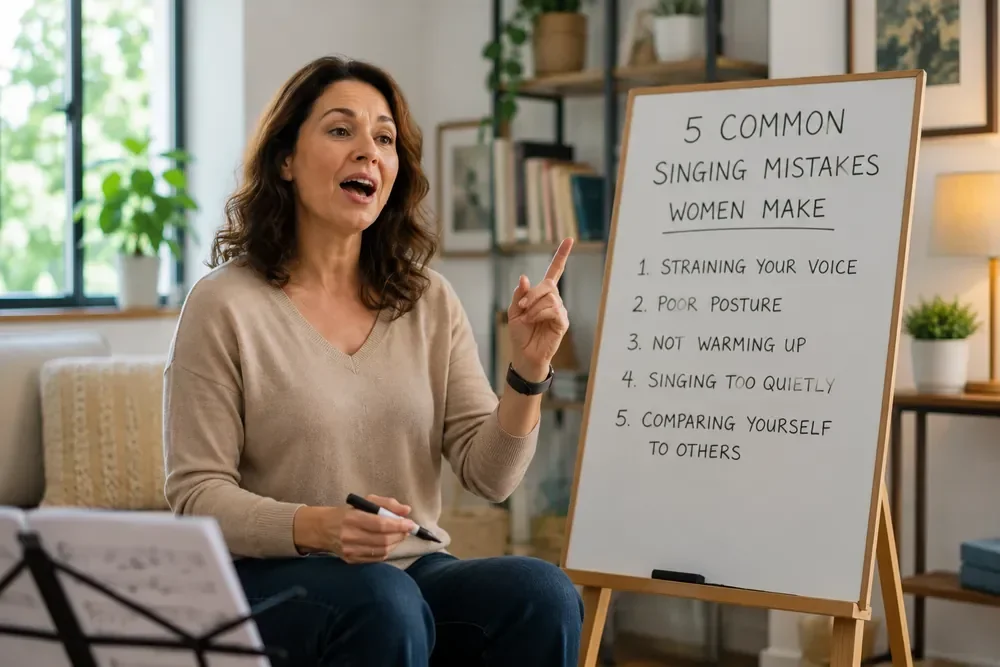
If you used to sing and you're finding your way back now, I want to start with something reassuring. The wobbles, the cracks, the moments that don't sound the way you remember are not signs that your voice is gone. They're signs that it's out of practice, which is a completely different thing.
After 25 years of coaching women returning to singing in their 40s, 50s and 60s, I've watched the same handful of habits get in the way over and over. Every one of them is fixable, and most of them are fixable faster than you would guess, because a habit is a pattern rather than a permanent feature.
The short version
The five that cost returning singers the most: expecting the old voice back immediately, skipping the warm-up, pushing volume from the throat, breathing into the chest instead of low and wide, and being brutal with yourself when it wobbles. Fix them one at a time, not all at once. Most women hear a real difference inside two to four weeks of short, gentle practice.
How do you know if you're singing incorrectly?
Your body tells you before your ears do. Run through this list after your next practice.
- Your throat feels scratchy, tired or tight when you finish.
- You run out of air partway through a phrase you used to manage easily.
- Your shoulders rise when you breathe in.
- The tone goes thin, breathy or swallowed rather than ringing.
- You feel a block or a squeeze in your throat as the pitch climbs.
- The same note breaks in the same place, in every song.
None of these mean damage. They mean effort is landing in the wrong place, usually the throat and neck rather than the breath. Two or more, and one of the five below is almost certainly the cause.
What are the five most common singing mistakes women make?
In the order I see them, and roughly in the order they cost you the most.
1. Expecting your voice to pick up where it left off
This is the big one, and it's emotional as much as technical. You remember how you sounded at twenty-five. Something different comes out now, and it's easy to decide you've simply lost it.
But a voice that hasn't been used in years behaves like any other part of the body that's been resting. The vocal folds are muscle and tissue that respond to conditioning, and the strength and flexibility are still in there.
The fix: meet your voice where it is today, not where it was. Give yourself a few low-pressure weeks of gentle, consistent practice before you judge anything. Range, control and tone all come back, but they come back to women who keep showing up, not to women who quit on day three.
One more thing worth naming. Your ear almost certainly survived the years away intact, and often improved, because listening keeps sharpening even while the voice sits idle. So you can hear exactly how rusty you sound, which makes the gap feel far bigger than it is. That is the judge improving while the athlete rested, not evidence of loss.
2. Skipping the warm-up
When time is tight, the warm-up is the first thing to go. You want to get to the song, so you launch straight in. The trouble is that cold vocal folds are stiff and unresponsive, and asking them for big expressive things without preparation is how you end up hoarse, flat or strained.
The fix: treat five minutes of gentle humming and light sirens as part of the singing, not a delay before it. The seven-exercise humming warm-up is the version I hand out most. Of everything on this list, this is the cheapest fix with the biggest payoff. Five minutes. That's the whole price. My vocal warm-up guide has the order that works.
If five feels impossible on a given day, do two. A short warm-up beats none by a wide margin, and the habit of always doing something is worth more than the extra three minutes.
3. Pushing for volume from the throat
So many women equate singing better with singing louder, and they try to manufacture that power by squeezing from the throat. It feels like effort, so it feels productive. It is also the fastest route to tension and that tired, scratchy feeling afterwards.
The fix: let volume come from breath rather than force. When you support a note with a steady stream of air from low in your body, the throat can stay relaxed and open. Think more air, not more push. A free, supported voice carries further than a forced one and won't leave you sore. If the squeeze shows up mostly at the top of your range, how to sing higher notes without straining deals with that specifically.
Here is a test you can run in ten seconds. Sing a comfortable note at your normal volume, then sing it again at half that, aiming for a clear rather than a big sound. If the quieter one felt easier and sounded cleaner, your loud version is being made in the throat.
4. Forgetting to actually breathe
It sounds too simple to be a real problem, but shallow chest breathing sits behind a huge share of what women bring into my studio. Breathe only into the top of the chest and you run out of air halfway through a phrase, your pitch sags, and your shoulders creep toward your ears. The voice has nothing to ride on.
The fix: practice breathing low and wide, so your ribs and belly expand rather than your shoulders rising. Before you sing, take a few slow breaths with a hand on your stomach and make sure it moves outward as you inhale. A couple of weeks of dedicated breathing exercises for singing will do more for your voice than almost anything else you could practice.
The reason this one pays so well is that nearly every other complaint on this page sits on top of it. Wobbly sustained notes, phrases that fade at the end, strained high notes and a throat that squeezes to compensate are all, underneath, an air problem wearing a different costume.
5. Being far too hard on yourself
Not a technical mistake, but possibly the most damaging one here. A voice crack, a missed note, a recording that makes you cringe, and the inner critic pounces. Many women stop singing altogether not because they can't improve but because that harsh self-talk makes practice feel awful.
The fix: talk to yourself the way you'd talk to a friend who was brave enough to try something new. Cracks and rough notes aren't failure; they're the sound of a voice rebuilding. Track small wins. Celebrate the days you showed up. If nerves and self-criticism are the main thing in your way, singing confidence tips goes further into it.
I have watched genuinely lovely voices stay locked inside parked cars for years because their owners could not face an audience of one. The technical work on this page is the easy part. This is the one that decides whether you are still singing in six months.
What else gets in the way?
Four more that show up constantly, and each takes about a minute to understand.
- Slouching. A collapsed ribcage physically cannot hold a steady column of air. Stand as though you're about to be introduced to someone: feet under your hips, shoulders down, chin level.
- Choosing songs that are too hard. If the chorus lives at the very top of your range, you will strain every single time, no matter how good your technique gets. Transpose it down two or three half steps. If you don't know where your range sits, the vocal range chart and the six voice types sorts that out in a couple of minutes.
- Mumbling the words. Lazy vowels and an unmoving mouth swallow the tone. Your mouth and throat are the resonators that shape and amplify the sound, so a closed mouth is a muted instrument. Open a little more than feels natural and let the vowels be tall.
- Only ever singing songs. Songs are why you came, but they don't isolate anything. Ten minutes of scales and sirens a week builds coordination that no amount of full-song repetition will.
How do you actually fix a singing habit?
One at a time, and slower than you want to.
Pick one thing every two weeks. Trying to fix your breathing, your posture, your volume and your self-talk in the same session guarantees you fix none of them. Habits are replaced by repetition, and repetition needs a single target.
Record yourself once a week, not once a day. Weekly is often enough to hear change and rare enough that you don't spiral. Keep the first recording. It will be the most encouraging thing you own in three months.
Practice the fix away from songs first. Get low breathing working on its own, in a chair, with a hand on your belly. Then take it into a scale. Then take it into one phrase. Going straight from idea to full song is why corrections evaporate the moment the music starts.
Expect it to feel worse before it feels better. A newly corrected habit feels awkward and often sounds smaller for a week or two. That's the sensation of an old shortcut being removed, not a step backwards.
What does a five minute session actually look like?
Most of these mistakes disappear on their own inside a session that has a shape. Here is the one I give returning singers who have five minutes and no privacy. If that is your everyday situation, practicing singing at home quietly covers the windows and the near-silent exercises in more depth.
- 1 min Stand tall, hand on your belly, and take slow low breaths. Belly moves out, shoulders stay still. This is the posture and breathing fix in one.
- 2 min Hum gently at about your speaking pitch, then slide the hum up and down a small interval. Quiet enough that the next room won't hear.
- 1 min Lip trills or a straw hum, gliding low to high and back. Let the tone thin as it rises rather than pushing.
- 1 min One phrase of a real song, in a comfortable key, at half your usual volume.
That last minute matters more than it looks. A warm-up that never reaches a song starts to feel like a chore, and chores get skipped by week three.
"Cracks and rough notes aren't failure. They're the sound of a voice rebuilding."
What can you stop worrying about?
Half of what returning singers treat as a mistake isn't one. Four you can put down today.
- Not reading music. Plenty of excellent singers never learned. You can pick it up later if you join a choir that sight-reads; it is not a prerequisite for anything on this page.
- Not owning a piano. A free tuner app on your phone does everything you need for pitch reference, and every exercise here works without accompaniment.
- Sounding breathy at first. A light, slightly airy tone in the early weeks is what a rebuilding coordination sounds like. It firms up. Chasing a big sound before the light one is stable is what causes the strain in the first place.
- Not sounding like the original artist. You are not supposed to. The version of a song that suits your voice, in your key, at your volume, is the one worth practicing.
At what age do singers peak?
Later than almost anyone expects, and the honest answer has two halves.
Raw range and stamina tend to be at their most flexible in your twenties and thirties. But that's the smaller half. Pitch accuracy, breath management, interpretation, phrasing, and knowing what to do with a lyric all keep improving for decades, and those are the things listeners actually respond to.
Most classical singers are considered to be at their best somewhere between their late thirties and their fifties. Plenty of the women I teach sound better at fifty-five than they did at twenty-five, with slightly less on top and considerably more everywhere else. How a woman's voice changes with age covers what genuinely shifts and what responds to training.
How long does it take to break these habits?
Faster than the habits took to form. Most returning singers feel a real difference within two to four weeks of short, regular practice, and dependable strength returns over two to three months.
The timeline depends far more on consistency than on talent or age. Five minutes most days beats an occasional long session, every time, because coordination is built by frequency rather than duration. Adult learners often correct habits faster than teenagers do, for the unglamorous reason that they practice with more focus and actually do what they're asked. If age is the specific worry, can anyone learn to sing answers it with the research.
Once these are handled, the full roadmap in my full guide to a better singing voice gives you the next steps. And if pitch rather than tension is your worry, why you sing off pitch and how to fix it is the one to read.
When is it a habit, and when is it medical?
Almost everything on this page is a habit with a habit-sized fix. A few things are not, and I would rather you knew the difference.
See a doctor, ideally an ENT who works with voices, if you have pain when you sing or speak, a hoarse voice lasting more than two weeks with no cold to explain it, a voice that tires within minutes of ordinary use, or a sudden change you cannot account for. Those are medical questions, and no amount of good technique resolves them.
Everything else is patience and repetition. Pick one habit, work it for two weeks, and let the rest wait their turn.
Frequently asked questions
What is the most common mistake women make when singing?
Expecting the voice to sound the way it did years ago, and giving up when it doesn't. A voice that has been resting isn't lost, it's out of condition, and a few weeks of gentle consistent practice bring back far more than most women expect. Patience is the real fix, and it is the one nobody wants to hear.
How do you know if you're singing incorrectly?
Your body signals it before your ears do. A scratchy or tight throat afterwards, shoulders that rise when you inhale, running out of air mid-phrase, a thin or swallowed tone, a feeling of blockage as the pitch climbs, or the same note breaking in the same place every time. None of these mean damage. They mean the effort is landing in your throat instead of your breath.
Why does my voice crack when I sing louder?
Usually because the extra volume is coming from throat pressure rather than breath support. Squeezing the throat destabilizes the vocal folds right where your registers meet, so the voice flips or cracks. Support the note with steady air from low in your body and let the throat stay relaxed, and the crack usually settles within a few weeks.
How long does it take to get your singing voice back?
Most returning singers feel real improvement within two to four weeks of short regular practice, and dependable strength returns over two to three months. The timeline depends far more on consistency than on talent or age. Five minutes most days beats an occasional long session.
Do vocal warm ups really make a difference?
Yes, and the difference isn't subtle. Warmed up vocal folds move more freely, so pitch is more accurate, tone is clearer, and strain drops sharply. Five minutes of humming and gentle sirens before singing is the highest return habit available to a singer at any level.
What should singers avoid?
Pushing volume from the throat, singing cold, choosing songs that sit at the very top of your range, and practicing while hoarse. Add shouting and heavy throat-clearing to the list, since both slam the vocal folds together. None of these ruin a voice overnight, but together they keep a returning singer permanently sore and permanently discouraged.
At what age do singers peak?
Range and stamina are usually most flexible in your twenties and thirties, but pitch accuracy, breath management, phrasing and interpretation keep improving for decades. Many classical singers are considered at their best between their late thirties and their fifties. Most women I teach sound better at fifty-five than at twenty-five, with a little less on top and considerably more everywhere else.
Is it too late to fix bad singing habits in my 40s or 50s?
No. Habits are patterns, not permanent features, and adult learners often fix them faster because they practice with more focus. In my studio, women in their 50s routinely retrain their breathing and release throat tension within a couple of months of consistent gentle work.
Be first in when the doors open.
Vocal Refresh is a daily practice app for women returning to singing after years away. A short voice check finds your range today, and you get a session built for the voice you have now. Private, no audience, no scores. Join the waitlist and we email you the day it opens.
Founding members pay $69.99 a year, held for three years. No spam. Leave any time.
Or start right now: take the free vocal range test.