How to Sing Again and Find Your Singing Voice
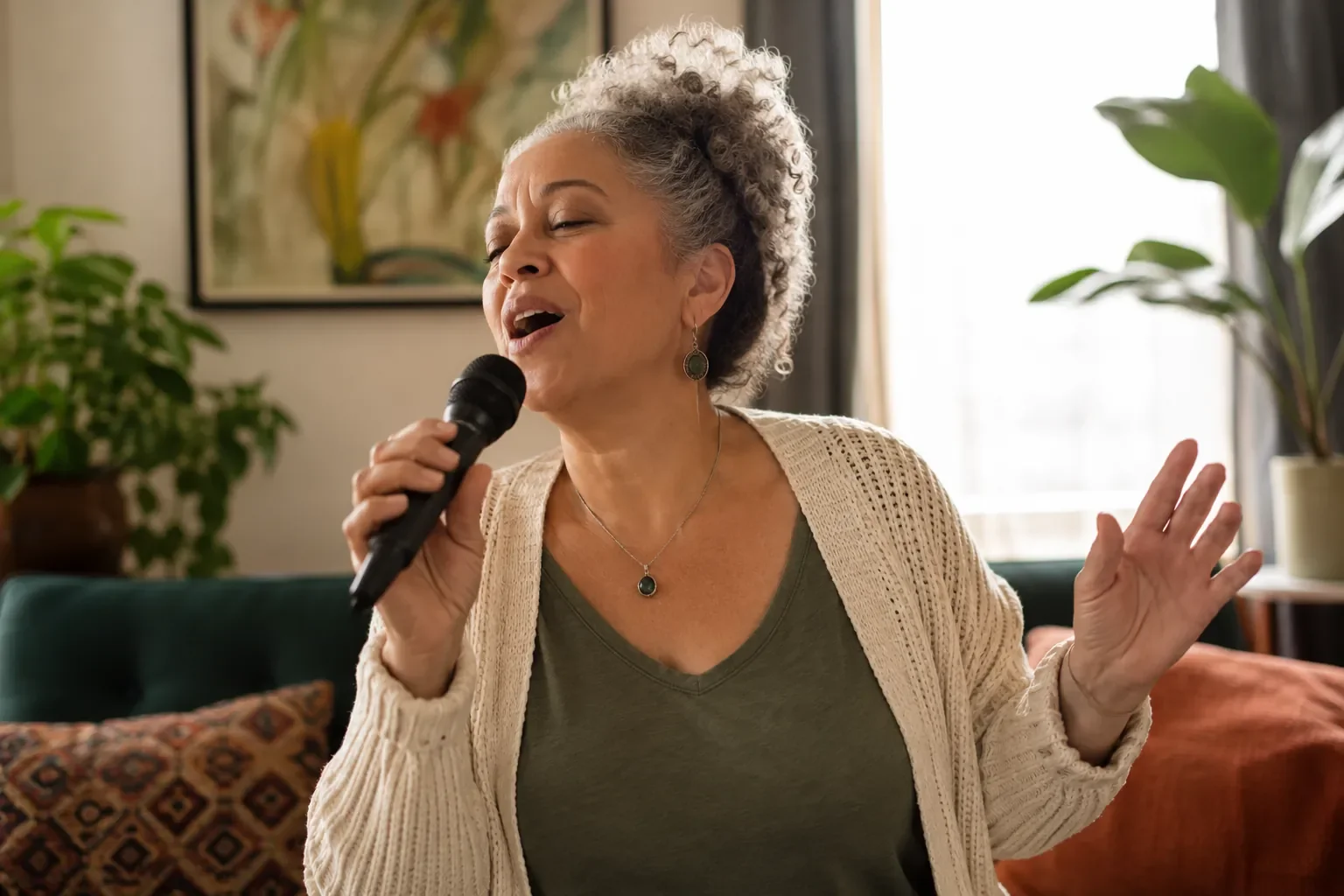
You used to sing. In a choir, in your school musicals, in the car with the windows down, around the house while your kids were small. Then life got loud, the singing quietly stopped, and now ten or twenty years have passed and you are wondering whether the voice you remember still exists.
It does. I want to say that plainly before anything else, because it sits underneath every other question women bring into my studio. A voice that has been resting is not a voice that has died. It is out of practice, which is a different problem entirely, and a fixable one. In 25 years of teaching I have never met an adult whose voice was actually gone. I have met hundreds who were convinced theirs was.
The short version
Your voice did not disappear; the coordination did. Rebuild it in this order: five minutes of daily breath work, then humming and lip trills, then sirens and scales, then songs in a key that fits the voice you have now. Most returning singers hear real progress in two to four weeks, and a voice that rested a decade takes around six months to feel fully reliable. Short daily practice beats one long weekly session every time.
Is your singing voice still there after years away?
Yes. Your vocal folds are living tissue, muscle and ligament wrapped in a delicate membrane. They do not dissolve from disuse. What fades is coordination: the timing between breath pressure, fold closure, and the shape of your throat and mouth. Timing is a motor skill, and motor skills return with repetition. Slower at 45 than at 15, sure. But they return.
Think of a piano that has sat untouched in the living room for a decade. It is out of tune and a few keys stick. Nobody looks at that piano and declares it can no longer be played. Your voice deserves the same logic.
Your ear, by the way, usually survives the break completely intact. Many returning singers hear pitch better than they did as teenagers, because decades of listening keep sharpening the ear even while the voice sits idle. That is a real advantage with one cruel side effect: you can hear exactly how rusty you sound, so the gap between your ear and your voice feels bigger than it actually is. Remember that on the discouraging days. The judge improved while the athlete rested.
What actually changes when you stop singing?
Honesty helps more than cheerleading here, so let me list the real changes.
Breath support goes first. The muscles between your ribs, and the reflexes that meter air out through a long phrase, lose conditioning like anything else you stop training. This is why lines that used to be easy now leave you grabbing a breath at the halfway point. It is also the fastest thing to rebuild, which is why it comes first in the plan below, and why breathing exercises for singing are where I start every returning student.
Coordination goes rusty next. The patch roughly between F4 and B4, where chest voice hands over to head voice, gets wobbly when it is not exercised. Cracks and flips live there. They are not damage; they are a handover that has not been practiced lately, and here is what is actually happening at that handover.
And the instrument itself has changed some. For women this is real and worth naming. Pregnancy, perimenopause and menopause all shift the hormones that keep the vocal folds plump and flexible. Speaking pitch often drops a little. The top of the range may sit a step lower than it did at 25, and the break can feel more exposed. If your voice sounds unfamiliar to you, that is not your imagination; why your singing voice sounds different after years away goes through the causes one by one.
Here is the reframe I offer in lessons, and I mean it as a technician, not as a comforter: most women in their 40s and 50s gain warmth and depth through the middle of the voice, and the bottom of the range often grows. Keys that once felt low start to feel rich. You are not getting your 20-year-old voice back. You are getting a voice, and through the middle it is frequently a better one.
How do you find your singing voice again?
Before the plan, a detour worth taking. Plenty of returning singers are not really asking how to hit notes again. They are asking what their voice even is now — its tone, its character, the songs that suit it. That question has its own answer, and it takes about ten minutes.
1. Start from your speaking voice
Your natural singing voice lives right next door to your comfortable speaking voice, not somewhere above it. Say "hello" the way you would answer the phone to a friend, brightly and without effort. Now hold the last part of the word and let it turn into a sustained "ah" on that same pitch. That note is home. Nearly everyone who thinks they cannot sing is starting somewhere else entirely — usually too high, occasionally pushed down into the throat because a low voice sounds more serious.
2. Hum, so you stop imitating someone else
Put your fingertips lightly on your lips and hum a tune you know well. Feel where it buzzes: the front of your face, around the nose and mouth. Humming strips away the impression you have been doing, without meaning to, of whichever singer you grew up loving. What is left is your own instrument. Almost every adult I teach has an inherited voice sitting on top of their real one, and humming is the fastest way to hear underneath it.
3. Find the stretch where it feels easy, and pick songs there
Slide gently up and down like a siren and notice where singing stops feeling like work. For most people that sweet spot is around an octave and a half wide, and it is where your voice sounds most like itself — not your highest notes, which is where everyone goes looking. Record a phrase there on your phone and listen back once, without grading it. Then choose songs that sit in that stretch. If the note names mean nothing to you, the vocal range chart and the six voice types decodes them in a couple of minutes.
That is the whole exercise. Your singing voice is not lost and it is not hiding; it is just quieter than the habits sitting on top of it.
What is the six-step plan to start singing again?
This is the sequence I give every returning singer. The order matters more than the pace. You can move through steps one to three in your first week and then live on steps four to six for months. If you want the same plan mapped week by week around small children, here is how to start singing again after a break.
1. Find out what you are working with
Before you sing a single scale, take a baseline: the lowest note you can sing without growling and the highest before things turn shouty or breathy. Write the result down with the date. Maybe today you get G3 to C5. In six weeks, that scrap of paper turns "I think I might be improving?" into "I have added three notes on top." Vague goals produce vague practice. A benchmark keeps you honest in both directions — it stops you despairing on bad days and coasting on good ones.
2. Rebuild your breath first
Singing rides on air. When the air is unsteady, everything above it wobbles, and no amount of effort in the throat can fix it. So breath comes before warm-ups, before scales, before songs.
Sit or stand tall with one hand on your lower ribs. Breathe in through your nose for a count of four and feel the ribs and belly widen under your hand. Your shoulders should not lift; if they do, the air is going into the top of your chest, where singers cannot use it. Then exhale on a steady, quiet "sss" for a count of eight. Over the coming weeks, stretch that exhale to twelve, then sixteen.
Five minutes of this, daily. It is the single highest-return practice on this entire page, which frustrates people, because it does not feel like singing. Do it anyway.
3. Warm up small, every day
For the first two weeks, your singing is humming, lip trills and small slides. That is the whole assignment, and it is enough.
Hum gently at about your speaking pitch until you feel a buzz in your lips and nose, then slide the hum up and down the interval of a third, like a lazy sigh. Then lip trills: blow air through loosely closed lips so they flutter, and glide up and down your easy range. If your lips refuse to trill (some never do, and it means nothing), humming through a drinking straw does the same job.
Five to ten minutes counts as a full session. None of it needs privacy or a piano. I have students who do the entire routine in the car after school drop-off, and one who hums through a straw while the kettle boils. Quiet counts. My complete vocal warm-up guide has a longer menu and the order to do them in.
4. Add real exercises and reclaim your range
After about two weeks of consistent breath work and humming, your voice is ready for actual exercises.
Start with sirens: an "ng" sound, as in the end of "sing", gliding from your low range to your high range and back, smooth as a distant ambulance. Sirens knit chest voice and head voice back together and find the wobbly patch in the middle without forcing it. Then five-note scales on "ee" and "ah", starting around A3 for most women and moving up by half steps until the top starts to feel like effort — then stopping. Then octave slides on "oo".
The rule for all of it: no pushing. If a note requires shoving, it is not ready yet. Range comes back from underneath, by making easy notes easier, not by lunging at high ones. This is the stage where most self-taught comebacks go wrong, so be more patient here than feels natural. If range is the specific thing you are chasing, the four-week rebuild plan sets out exactly how far to reach each week.
5. Sing actual songs, in keys that fit you now
Exercises are the vegetables. Songs are why you came.
Pick one song you love and can already mostly sing, not the one you plan to conquer someday. Then check the key. If the original sits too high, take it down a whole step, or two, without apology. Professional singers transpose constantly; the audience never knows and never cares. Karaoke apps and YouTube make it trivial to find a track in a lower key.
Learn it in sections, one phrase at a time, and expect your first week of song work to sound worse than your humming did. Songs demand consonants, jumps and memory all at once. The dip is normal and it is short.
6. Let someone hear you
Fear of being heard silences more grown women than any lack of ability ever has. I have watched genuinely lovely voices stay locked inside parked cars for years because their owners could not face an audience of one.
So make the audience exactly one. A partner, a friend, your sister on a video call. One verse, that is all. A pounding heart is allowed and expected. The point is not their review. The point is that the wall between "I sing secretly" and "I sing" only comes down by walking through it once.
If you are starting from scratch rather than returning, here is how to learn to sing as an adult, step by step.
What does the first month look like?
If you like structure, here is how those steps lay out across four weeks. Treat it as a rhythm, not a law.
- Week 1 Five minutes daily: breath work plus gentle humming, attached to something you already do, like the drive home or the coffee brewing. Nothing else.
- Week 2 Keep the daily five minutes and add two 15-minute sessions with lip trills and slides. Record yourself once on your phone. You will hate the recording. Everyone hates the recording. Keep it anyway, because it is your "before".
- Week 3 Add sirens and five-note scales to the longer sessions, and start learning your one song. If you feel brave, sing a verse for one person.
- Week 4+ Settle into four to six short sessions a week. Re-test your range, compare recordings, pick the next song.
Notice what this plan never asks for: an hour of free time. Four to six short sessions a week beat one heroic Sunday session so decisively that I would rather a student practiced five minutes daily than sixty minutes weekly. The voice rebuilds on frequency. Consistency beats intensity, every single time.
How do you practice when your days are already full?
Most of the women I teach are not short on desire. They are short on minutes, and their own needs have sat at the bottom of the list for years.
So put the practice where the minutes already are. The car is a rehearsal studio with decent acoustics and a lockable door. The kitchen during dinner prep handles humming just fine. The shower flatters everyone's tone, and honestly, take the flattery; encouragement is fuel. Waiting rooms and school pickup lines can host silent breath work that nobody around you will ever notice.
One more habit worth stealing: within half an hour of warming up, use your voice for something real. Sing along to one song in the kitchen, or run the verse you are learning. A warm-up that leads nowhere starts to feel like a chore; a warm-up that opens into actual singing feels like a beginning.
How long does it take to get your singing voice back?
A fair question, and I will not fudge it. Think weeks for the first real progress and months for the full picture.
Within two to four weeks of consistent short practice, most returning singers notice easier speaking, steadier sustained notes and a smoother handover between registers. Range and stamina take longer: expect real movement between weeks four and eight, and give the very top of your range the most grace, because it comes back last. A voice that rested for fifteen years may need six months to feel fully like yours again.
"Set against fifteen years of silence, six months is nothing."
What does singing give you back?
I want to name something the exercise lists skip. For many women the voice did not fade because of anything in the larynx. It faded because somewhere between the job, the kids and everyone else's needs, singing started to feel self-indulgent, so it got cut first. What comes back is not only the voice — the benefits of singing that hold up best in the research are mood, calm, and feeling less alone. Singing with other people amplifies that last one more than anything you can do solo, which is why the benefits of group singing are mostly social ones.
Which means those ten minutes of humming in the car are doing double duty. They recondition muscle, yes. They are also a standing appointment with the version of you that existed before your time belonged to everyone else, and in my experience that appointment does as much for the comeback as any scale. Students who frame practice as something they are reclaiming stick with it. Students who frame it as one more obligation quietly stop by week three.
Helpfully, you do not have to slog toward some distant reward to justify it. The practice feels good in the first week, long before it sounds good. Humming lowers your shoulders. Singing one verse in the kitchen changes the mood of an evening. That early payoff is what carries you through the weeks when progress is quiet. And if you are still wondering whether the door is even open at your age, is it too late to learn to sing walks through what the research actually says.
When should you see a doctor, or hire a teacher?
Most returning voices need only patience and repetition. Some need more, and I would rather you know the signs than push through them.
See a doctor, ideally an ENT who works with voices, if you have hoarseness lasting more than two weeks with no cold to explain it, pain when you sing or speak, a voice that tires within a few minutes of use, or a sudden change you cannot account for. These problems are usually minor and treatable, but they are medical questions rather than technique questions, and no exercise on this page fixes them.
A voice teacher is a different decision, and my honest advice is that you do not need one to start. When you do start weighing it up, I have written out how lesson prices compare with an app. If an app is how you want to restart, read the Simply Sing review before you pay for a subscription. Run the plan above for six weeks first. If you are still showing up at week six, you have proven the commitment, and a good teacher, in person or online, will save you months of trial and error, especially around the register break. If money is tight, even one single lesson to check your breath habit beats a year of guessing.
Frequently asked questions
Can I get my singing voice back after 10 or 20 years?
Yes. Vocal folds are muscle and ligament, and the coordination that faded from disuse rebuilds with repetition at any age. Expect the first noticeable progress within two to four weeks of short daily practice, and a fuller recovery over several months. The length of the break matters far less than the consistency of the comeback.
How do I find my actual singing voice?
Start from your comfortable speaking voice rather than reaching for a high note, then hum with your fingertips on your lips so you stop imitating whichever singer you grew up loving. Slide gently up and down to find the octave and a half where singing stops feeling like work, and choose songs that sit there. Your real voice is usually the one underneath the habits, not above them.
Why does my singing voice sound worse after years of not singing?
Two reversible reasons. Your breath support muscles have lost conditioning, so notes waver and phrases run out of air. And the fine coordination between your registers has gone rusty, so the middle of your voice feels wobbly. Your ear, meanwhile, stayed sharp, which makes the gap sound bigger than it is. Daily breath work and gentle humming close it faster than most people expect.
How long does it take to get your singing voice back?
Most returning singers notice easier, steadier singing within two to four weeks of practicing five to ten minutes most days. Range and stamina typically rebuild between weeks four and eight. A voice that rested for a decade or more can take around six months to feel fully reliable again. Short frequent sessions speed this up; occasional long ones do not.
Should I take singing lessons to start singing again?
Not right away. Start on your own with breath work, daily humming and a baseline range test, and give it six weeks. If you are still practicing at that point, a teacher becomes a worthwhile investment and will speed up work on your register break especially. If you notice pain or lasting hoarseness at any stage, see a doctor before booking lessons.
Is it too late to start singing again at 40, 50 or 60?
No. The voice changes with age, especially through menopause, but it stays trainable for life. Many women find their middle range warmer and their low notes stronger in their 40s and 50s than they were at 25. Choirs and studios are full of singers who came back in midlife. What a returning voice needs is gentle daily use, not youth.
Built for exactly this comeback.
Vocal Refresh is a daily practice app for women returning to singing after years away. A short voice check finds your range today, and you get a session built for the voice you have now. Private, no audience, no scores. Join the waitlist and we email you the day it opens.
Founding members pay $69.99 a year, held for three years. Or start right now: take the free vocal range test.