How to Safely Rebuild Your Vocal Range After Years Away
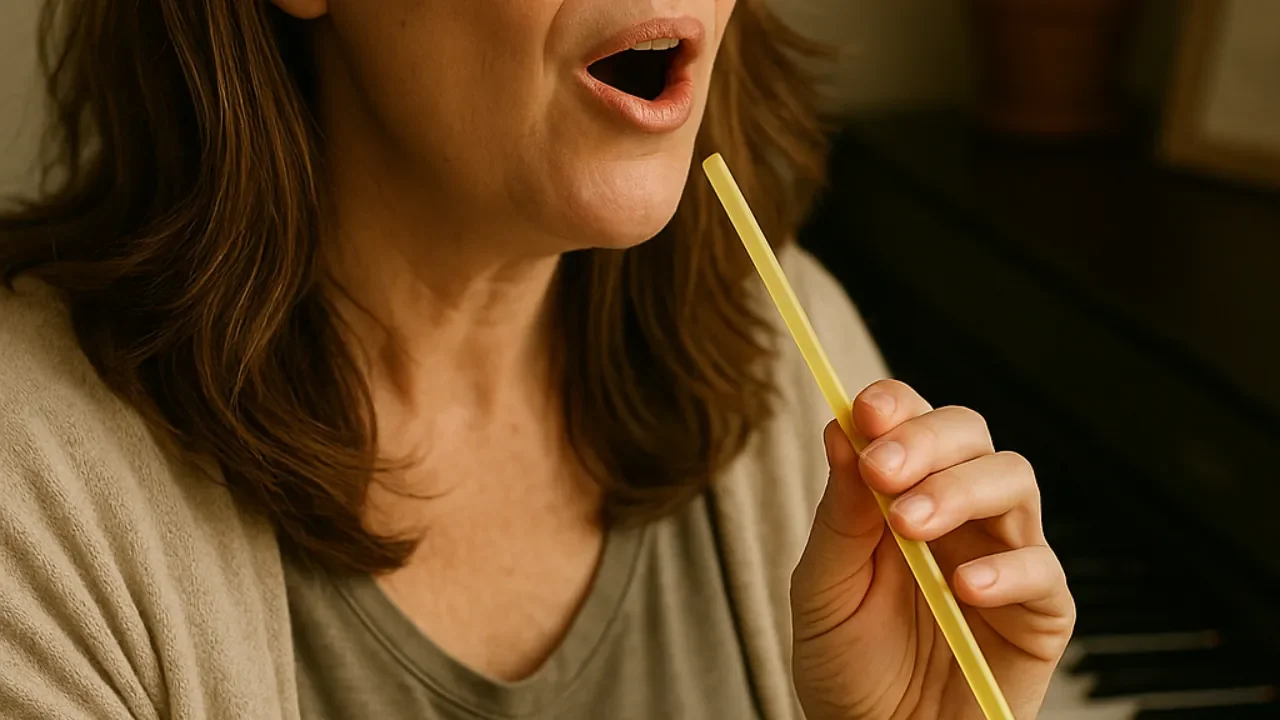
You used to have a dependable high F, maybe more. Then came a decade of work, kids, or simply life without singing, and now the same note comes out thin or not at all. I hear a version of this story most weeks in my studio, and my answer barely changes: the notes are not gone. Range that was built once can be rebuilt, and usually faster than it was built the first time.
Range is one piece of a bigger comeback — if you are starting from zero, how to sing again covers the whole journey back. This post is the range piece specifically: why it shrank, a four-week plan to bring it back, and how to tell the difference between productive effort and the kind that sets you back a week.
The short version
Most range loss after a long break is deconditioning, not damage, and deconditioning reverses. Work in this order: reconnect inside your comfortable range for a week, then stretch the edges by about two semitones a week, then add strength, then open to full voice. Ten to fifteen minutes a day, five or six days a week. Straw phonation is the single most useful exercise in the set, because the narrow tube holds pressure above your vocal folds so they can vibrate through their full range with far less impact.1 Take a baseline measurement before you start, because the returning singer's biggest obstacle is usually the belief that nothing is improving.
Why your range shrank
Three things happen to a singing voice that sits unused, and it is worth separating them, because two are reversible on a timescale of weeks and one is not really about the break at all.
The muscles decondition. Your cricothyroid muscle stretches the vocal folds longer and thinner for high notes; your thyroarytenoid shortens and thickens them for low, full ones. Leave either unemployed for years and it weakens like any other muscle. Think of your legs after a decade without running: nothing is broken, but the first jog is humbling.
The coordination goes quiet. This is the bigger one, and the more encouraging one. Singing a high note is not raw strength, it is a precise negotiation between air pressure, fold tension and vocal tract shape. That coordination is a motor skill, and motor skills degrade with disuse and return with practice much faster than they were first learned. It is why week two of a rebuild so often produces a note that felt impossible in week one.
Breath support fades. Years of shallow desk-and-phone breathing leave you without the steady air pressure both ends of your range depend on, so the edges wobble and quit early. If your phrases run short before your voice does, start with breathing exercises for singing and let the range work follow. Retraining the breath to come from the belly is the piece that makes the rest hold.
The break deconditioned your muscles and dulled your coordination. It did not change your instrument. Those are very different problems, and only one of them takes years.
What a break does not do is age your vocal folds faster. The tissue changes people worry about — collagen and elastin reorganizing in the lining of the fold, mild muscle atrophy, stiffening in the small laryngeal joints — are age-related and run on their own clock whether you sing or not.2 They matter later and they matter less than most returners fear. And the same review found voice therapy effective for the aging voice, which is a useful thing to know if you are coming back at 60 rather than 40. I go through that in more detail in how a woman's voice changes with age.
Rebuilding after menopause has an extra hormonal layer worth understanding first.
Before week one: get a number
Take a baseline. This sounds like an optional first step and it is the one I would refuse to skip, because during a rebuild your ears are the least reliable instrument in the room. Progress arrives in single semitones, which is far too small to feel, and the story in your head is usually "nothing is happening." A number settles that argument.
Then hold to three rules for the whole four weeks.
| Rule | Why it matters |
|---|---|
| Fifteen minutes maximum, after warming up | A deconditioned voice tires fast, and tired practice teaches the compensations you will spend next month undoing. Short and frequent beats long and occasional every time |
| Start from today's comfortable limits, not the notes you remember | Your old peak is the destination, not the starting line. Reaching for a remembered note is the single commonest way returners strain themselves in week one |
| Stop on sharp pain, sudden hoarseness, or a tightening neck | Mild effort and mild fatigue are normal and expected. Those three are not, and none of them improves by pushing through |
The four-week range ladder
Ten to fifteen minutes a day, five or six days a week. Each week adds either a little stretch or a little load — never both at once. That constraint is the whole design, and it is what makes this safe to do without a teacher watching.
| Week | What you do | How far to reach | What it builds |
|---|---|---|---|
| 1. Reconnect | Straw phonation sirens and lip trill scales | Comfortable range only. No expansion at all | Coordination and blood flow. Waking things up |
| 2. Stretch the edges | Octave slides on "oo" and hummed arpeggios | About two semitones past week 1 in each direction | Fold length and flexibility at both extremes |
| 3. Add strength | "Nay" arpeggios, keeping straw and humming as warm-up | Hold week 2's range. Do not extend further | Firm fold closure without pressing. This is where power comes from |
| 4. Full voice | Open arpeggios on "ah" plus mix drills on "yeah" | Another two semitones if week 3 felt easy | Connected tone across the registers. It starts sounding like singing |
Week 1: reconnect
Everything inside your current comfortable range, on purpose. No expansion. This week wakes up muscles and coordination that have been idle, and if it feels too easy, good — easy is the assignment. The temptation to skip ahead is strongest here and the cost of giving in is highest, because a deconditioned voice usually feels fine right up until it does not.
Week 2: stretch the edges
Octave slides on "oo" and hummed arpeggios, singing the notes of a chord one at a time, bottom to top and back. Extend about two semitones in each direction past where week 1 sat, and no further — even on the days you feel wonderful. Especially on those days.
Week 3: add strength
Bring in "nay" arpeggios: a slightly bratty, nasal "nay nay nay" up and down the chord. The sound is unglamorous, but that buzzy edge trains your folds to close firmly without pressing, which is where sustainable power comes from. Hold the range you reached in week 2 rather than adding to it, because this week the new variable is load.
Week 4: full voice
Open up to full voice arpeggios on "ah" and add mix voice drills on "yeah" through the upper middle of your range. This is the week the exercises start sounding like singing again, and for most of my students it is also the week the grin comes back. If you want to keep pushing the ceiling after this, how to sing higher notes without straining takes over where this plan stops.
Straw phonation, done properly
If you only do one exercise from this page, do this one. It is the most-used tool in voice clinics for a reason, and almost everyone doing it at home is doing at least one thing wrong.
Take a narrow straw — a cocktail straw is ideal — seal your lips around it, and siren gently up and down as if singing "oo" through it.
Why it works
Here is the actual mechanism, because "it protects your voice" is not much of an explanation. The narrow straw creates high resistance at your mouth, which holds air pressure above your vocal folds through the whole vibration cycle. That positive pressure keeps the folds slightly apart while they oscillate, so instead of slamming together the way they do in ordinary speech, they vibrate in a smooth, near-sinusoidal pattern with very little collision.1
The practical consequence is the useful part: you can work the extreme edges of your range, where the folds are stretched thinnest and are most vulnerable, at a fraction of the usual impact. That is why it is safe to do daily during a rebuild when full-voice scales at the same pitches would not be. If you want to see where those edges sit against the six voice types, the vocal range chart lays them all over a keyboard.
It also has trial evidence behind it, which is rare for singing exercises. A 2025 randomized controlled study put 44 people with voice disorders into four groups — lip trills, straw phonation, vocal function exercises, and no treatment — for six sessions. All three exercise groups improved significantly on both acoustic measures and listener ratings compared with no treatment, with lip trills edging ahead.3 Worth noting that this was a clinical population rather than healthy returning singers, so read it as evidence the mechanism does something real, not as a promise about your top note.
How to do it
- 30 secSeal properly and check for leaks. No air should escape around the straw or through your nose. If you can hum while doing it, air is going out your nose and you have lost the back pressure that makes the whole thing work.
- 2 minSlide, do not sing. Gentle sirens from the bottom of your comfortable range to the top and back. Continuous glides, not separate notes.
- 2 minKeep it quiet. A slight buzz or tickle in your lips and cheeks means you have it right. If it is loud or effortful, you are pressing.
- 1 minTake the straw away and sing one phrase. This is the step everyone skips, and it is where the benefit actually transfers. The straw sets up a feeling; singing immediately afterward teaches your voice to keep it.
| Common mistake | What it feels like | Fix |
|---|---|---|
| Straw too wide | Easy, almost like normal singing, no buzz anywhere | Switch to a cocktail or coffee stirrer straw. Width is what creates the resistance |
| Air escaping through the nose | You can hear a hum alongside the straw tone | Pinch your nose for one slide. If the sound barely changes, you were leaking |
| Pushing for volume | Effortful, tight, sometimes lightheaded | Halve the loudness. This exercise is meant to feel almost lazy |
| Doing it for ten minutes straight | Fine at the time, tired an hour later | Two to five minutes is plenty. It is a primer, not a workout |
| Never transferring to real singing | Great through the straw, unchanged without it | Always follow with one sung phrase while the sensation is fresh |
Mix voice arpeggios
In week 4, sing arpeggios on "yeah" through the zone where chest voice and head voice meet, roughly A4 to E5 for most women. You are aiming for a sound that is neither yelled from below nor fluty from above, but something warm in between.
Do not chase perfection here. A settled mix takes months, and this week you are reintroducing your registers to each other rather than marrying them off. If the whole chest-versus-head distinction is fuzzy, that post lays out what is actually happening in each.
Reading your own signals
The hardest part of rebuilding without a teacher is not knowing which sensations to respect. Here is the triage I give students.
| What you notice | What it usually means | What to do |
|---|---|---|
| Mild tiredness after practice, gone by morning | Normal training response | Carry on. This is the point |
| Hoarse the next morning | You did too much, or pushed too high | Take a full day off, then come back at half the volume and the previous week's range |
| Voice cracks in the middle, not at the top | Register transition, not damage. Very common in returners | Keep going — more straw work, more mix drills. Why your voice keeps cracking covers the causes |
| Top notes fine one day, gone the next | Usually sleep, hydration, or hormonal timing rather than technique | Sing the day you have, not the day you wanted. Do not chase a note that was there yesterday |
| Tightening or aching in the neck and jaw | Recruiting muscles that should not be involved | Stop for the session. Return to straw and lip trills only for two or three days |
| Sharp pain, or hoarseness lasting over two weeks | Outside the scope of practice adjustments | Stop and see a doctor or an ENT before training further |
When you are ready for songs
When you can do the week 4 exercises comfortably three days in a row, with no strain during and no hoarseness the next morning, you are ready for repertoire.
Choose kind songs first — ones that sit in the middle of your rebuilt range rather than testing its edges. "Stand by Me" and "Let It Be" territory. Take anything down a key or two without apology; the audience cannot hear the key, only the comfort. Save the big ballads for a month or two later.
From there the work shifts from rebuilding to extending, which is a different toolbox. Vocal exercises for singers picks up exactly where this plan ends.
And keep measuring. Retest at the end of week 2 and again after week 4. Watching semitones come back in black and white is the best cure I have found for the "my voice is gone" story, and it takes two minutes.
Sources. 1. Titze, I. R. (2009). Phonation threshold pressure measurement with a semi-occluded vocal tract. Journal of Speech, Language, and Hearing Research, 52(4), 1062–1072. 2. Galluzzi, F., & Garavello, W. (2018). The aging voice: a systematic review of presbyphonia. European Geriatric Medicine, 9(5), 559–570. 3. Narasimhan, S. V., Raju, M., Shivaramu, N., & Thimmaraju, A. (2025). The impact of semi-occluded vocal tract exercises on multidimensional measures of voice in dysphonia: a randomized controlled study. Journal of Voice.
Frequently asked questions
How long does it take to get your vocal range back after years of not singing?
In my studio, most returning singers recover the bulk of their old range within four to eight weeks of consistent gentle practice, with the last few semitones at the very top taking a few months more. That is a clinical observation rather than a research finding, so treat it as a rough expectation rather than a schedule. The pattern holds even after decades away, though the first two weeks feel slower the longer the break was. What predicts the pace is not how long you stopped but whether the practice is frequent, short and unforced.
Is lost vocal range permanent?
Rarely. Range lost to disuse comes back with reconditioning, and disuse explains most cases in adults who simply stopped singing. Aging does shift the voice, with documented changes in the lining of the vocal folds, mild muscle atrophy and stiffening of the small laryngeal joints, but those run on their own timeline whether you sing or not, and voice therapy has been shown to help even then. The cases worth taking seriously are different in character: a specific note that vanished suddenly, or hoarseness lasting more than two weeks. Both warrant a doctor before more training.
What is straw phonation and why does it work?
Straw phonation means singing gentle slides through a narrow straw, lips sealed around it, as if humming "oo". The narrow opening creates resistance at your mouth that holds air pressure above the vocal folds throughout the vibration cycle. That pressure keeps the folds slightly apart as they oscillate, so they vibrate smoothly instead of colliding the way they do in normal speech. The practical payoff is that you can work the extreme top and bottom of your range, where the folds are most vulnerable, with far less impact than singing those same notes out loud. Speech pathologists use it for voice recovery, and it needs nothing but a cocktail straw.
How long should you do straw phonation each day?
Two to five minutes is plenty, and more is not better. It is a primer that prepares your voice rather than a workout that builds it, and people who grind away at it for ten or fifteen minutes usually end up tired rather than warmed up. Once a day before you sing is the standard dose during a rebuild, and twice on days when your voice feels stiff. The single most important detail is not duration but what follows: always sing one real phrase immediately afterward, while the easy sensation is still fresh, because that is the step that transfers the benefit to actual singing.
Can you actually increase your vocal range, or only free up what you already have?
Both, and the distinction matters less than it sounds. Most of what feels like new range in the first two months is recovered range: notes you owned before, unlocked by better coordination, firmer fold closure and steadier breath. Genuine expansion past your previous best is possible too, but it arrives slowly, in semitones over months, and it comes from technique rather than effort. The practical upshot is the same either way. Work gently at the edges, add either stretch or load but never both at once, and let the top build itself.
Can I skip week 1 if it feels too easy?
I would not. Week 1 is meant to feel easy, because its job is reawakening coordination rather than challenging you, and coordination returns before capacity does. That gap is exactly the trap: a deconditioned voice often feels fine right up until it does not, and the hoarseness shows up the next morning rather than during the session. Give it the full week. If everything still feels effortless at the end of it, move through week 2 a little faster instead, which puts the extra ambition somewhere it can do less harm.
Should I practice every day while rebuilding my range?
Five or six days a week is the sweet spot, ten to fifteen minutes at a time. Frequent short sessions rebuild coordination faster than long occasional ones, because what you are retraining is a motor skill rather than raw strength, and motor skills respond to repetition more than duration. One full rest day a week gives the tissue time to adapt. If you wake up hoarse, take an extra day off and shorten the next session rather than pushing through, which is the mistake that turns a good month into a stalled one.
Why does my voice crack in the middle of my range when I come back to singing?
Almost always because of the register transition rather than anything wrong. The passage where chest voice hands over to head voice, roughly A4 to E5 for many women, needs constant small adjustments in fold tension and air pressure, and that coordination is the first thing to go quiet during a break and among the last to return. It is not damage and it is not a sign you have lost the note above it. Straw phonation and mix drills on "yeah" through that zone are the fastest fix. Cracking that comes with pain, or hoarseness that outlasts the session, is a different matter and worth having looked at.
The four-week ladder, with something keeping score.
Vocal Refresh is a daily practice app for women returning to singing after years away. A short voice check finds your range today, and you get a session built for the voice you have now. Private, no audience, no scores. Join the waitlist and we email you the day it opens.
Founding members pay $69.99 a year, held for three years. No spam. Leave any time.
Or start right now: take the free vocal range test.